Revenue Operating Systems: A New Category, Explained

Revenue operating systems promise to replace the CRM as the system of record for GTM teams. Here’s what the category actually means in practice.
Sales and marketing teams have spent years adding applications to manage different parts of the go-to-market process. The CRM stores accounts and opportunities, sales engagement software runs outreach, analytics platforms report performance, and enrichment providers supply additional prospect information. Each application solves a specific problem, but the information and workflows connecting them often remain fragmented.
AI agents expose the limitations of this arrangement. An agent can write an email or identify a promising account, but acting effectively requires access to account history, buying signals, previous conversations, and the results of earlier campaigns. When that context sits across disconnected systems, automation becomes harder to coordinate and evaluate.
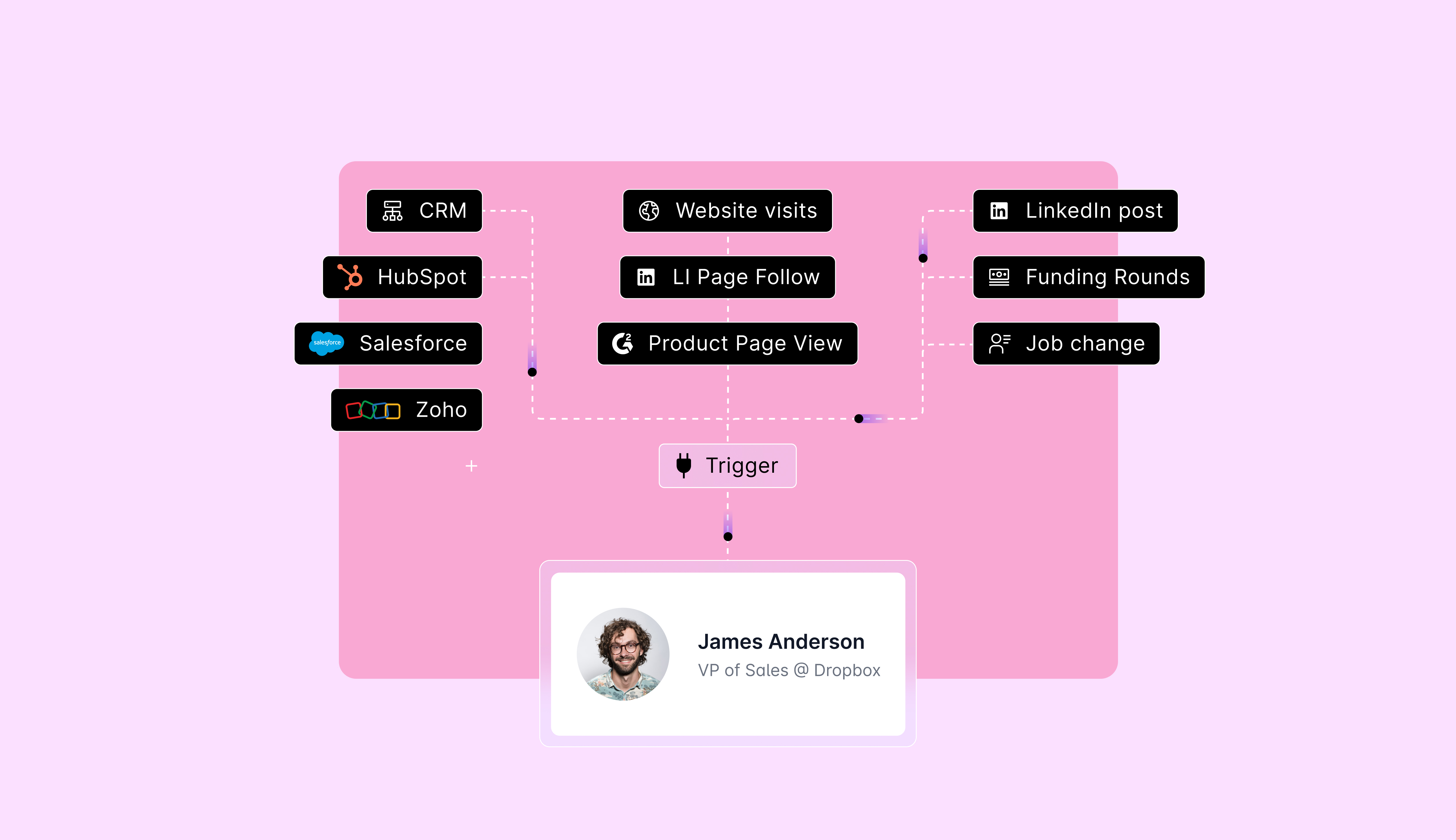
The idea of a revenue operating system has emerged from this problem. Rather than treating every application as an isolated destination, the concept brings go-to-market data, intelligence, and execution into a more connected environment.
TL;DR: A revenue operating system connects CRM history, customer interactions, product behavior, and external signals to help coordinate AI-driven sales and marketing activity. It represents a broader architectural ambition than a conventional CRM upgrade, but buyers should distinguish the category's claims from the capabilities a platform can demonstrate.
Why the CRM alone stopped being enough
The CRM remains an important part of most B2B revenue operations. It records contacts, accounts, opportunities, activities, and sales stages, giving teams a shared place to track commercial relationships.
The problem arises when the CRM becomes the only place sales leaders look for an accurate picture of buyer activity.
A prospect's CRM record might show an open opportunity, but it may not reflect the company's latest product usage, recent website behavior, current hiring plans, or a conversation another team member had through a separate channel. Those details may exist in other applications, but representatives must find and interpret them before deciding what to do.
This creates a recurring gap between information and action. Salespeople spend time researching accounts, copying information between systems, and updating records. Managers review dashboards to identify trends, then ask teams to implement changes through separate applications.
AI does not automatically resolve these problems. An agent connected to incomplete CRM data can recommend something that overlooks important context. Connecting several agents to different applications can create an additional coordination problem if they operate with different information or conflicting rules.
Alta's article on AI GTM systems of action examines this limitation and argues that automating isolated workflows can increase activity without improving pipeline. The broader architectural question is how information gathered in one part of the revenue process can inform decisions and execution elsewhere.
This is the problem a revenue operating system attempts to address. It aims to reduce the gap between the systems that store commercial information and the workflows that use it.
The distinction is important, though. A CRM can already integrate with external applications and support automation. A new category must demonstrate more than connectivity to justify being treated as fundamentally different.
What a revenue operating system actually unifies
There is no single, universally established definition of a revenue operating system. Vendors may use the term differently, so the practical meaning depends on the architecture and capabilities of the product being evaluated.
At its most useful, the concept describes a connected environment that combines four layers.
1. Systems of record. These include the CRM and other applications that maintain authoritative business records. Accounts, contacts, opportunities, orders, and customer relationships need reliable identifiers and clearly defined sources of truth.
2. Behavioral and external data. Website interactions, product usage, call transcripts, email engagement, company news, hiring activity, and third-party intent signals can provide context that structured CRM fields do not capture on their own.
3. Intelligence and context. These sources need to be connected, interpreted, and prioritized. The system should help determine which signals matter for a particular account, what a sales team already knows about the buyer, and what action may be appropriate.
4. Execution and feedback. AI agents and automated workflows can use that information to research prospects, initiate outreach, qualify inbound leads, update records, and coordinate follow-up. The results then feed back into subsequent decisions.
The value comes from how these layers work together. If a prospect asks an inbound agent about an integration requirement, that information should be available to the representative who follows up. If an outbound campaign generates qualified meetings from a particular customer segment, the system should be able to use the resulting evidence to inform future targeting.
This requires more than moving data into a central dashboard. Information must have consistent meaning, remain sufficiently current, and reach the systems responsible for executing actions.
Alta's guide to revenue intelligence discusses the role of integrated sales data, analytics, forecasting, and performance insights. A revenue operating system extends the idea by attempting to connect those insights to the execution of sales and marketing workflows.
How AI agents fit into this model
AI agents provide the execution layer that makes the revenue operating system concept different from a conventional reporting environment.
A dashboard can identify that a group of accounts converts well. Someone usually has to interpret that finding, create a new audience, update a campaign, and monitor the results. An agent-based system aims to connect more of those steps.
For example, a revenue system might detect that several target accounts have recently hired sales leaders. It could compare those companies with the ideal customer profile, review existing CRM relationships, and identify relevant contacts. After applying qualification rules, it might prepare personalized outreach or enroll eligible prospects in an approved campaign.
The workflow can continue when new information arrives. A reply might trigger qualification questions, a positive response could lead to scheduling a meeting, and the outcome could update the CRM.
Alta's AI Growth Agent illustrates this model. The product connects CRM information, enrichment sources, and other go-to-market signals to identify patterns, recommend actions, and help coordinate targeting and outreach.
However, autonomy introduces requirements that basic integrations may not address adequately. Agents need permission boundaries, reliable context, clear instructions, and a way to handle uncertainty. The system should know when to update a record automatically, when to request approval, and when an exception requires human intervention.
The feedback loop also needs to be meaningful. A campaign generating more emails is not necessarily improving performance. The system should evaluate outcomes such as qualified meetings, opportunity progression, and closed revenue rather than treating activity as success.
Forbes' article on AI agents and systems of record makes a related argument: agents depend on accurate, authoritative business data to execute workflows reliably. This is an important qualification to claims that AI can simply replace existing business applications. Intelligence and execution still need dependable records, controls, and auditability.
Where this category overlaps with existing tools
Revenue operating systems overlap with several established software categories. Understanding those relationships helps buyers determine whether a product provides genuinely new capabilities or combines functions they already have.
The categories are not mutually exclusive. CRM providers already offer automation, analytics, and AI capabilities, while sales engagement platforms increasingly incorporate intelligence and agent-like workflows. Some revenue operating system products may integrate these functions rather than replace the applications themselves.
Alta's integrations directory shows how a connected revenue environment can work alongside systems such as Salesforce, HubSpot, sales engagement platforms, analytics services, and data providers.
For many organizations, this is the more realistic deployment model. The business can retain its existing CRM and other systems while introducing an intelligence and orchestration layer on top.
That raises a more useful question than whether the new category will replace the CRM: which parts of the revenue process remain disconnected today, and what would it take to coordinate them reliably?
If existing applications already share accurate data, support consistent workflows, and provide adequate automation, adopting a new platform may offer limited additional value. If the business repeatedly reconciles information manually or struggles to coordinate actions across teams, a connected operating layer may address a genuine gap.
Questions worth asking before adopting one
A revenue operating system can affect much of the go-to-market stack, so procurement should focus on demonstrated operational improvements rather than category terminology.
Start with the workflows causing the most friction. Identify where information is fragmented, which decisions require manual analysis, and which activities consume time without contributing much to customer interactions.
Then assess potential platforms against specific requirements.
- Data integration: Can the platform connect to your existing CRM, product analytics, communication systems, and relevant external sources? Are the integrations genuinely bidirectional where necessary?
- Data quality: How does it handle duplicates, conflicting records, missing fields, and outdated information? Can users trace important recommendations to their sources?
- Execution controls: Which actions can agents take automatically, and which require human approval? Can permissions be restricted by role, workflow, or action type?
- Feedback and measurement: Does the system evaluate qualified pipeline and revenue outcomes, or does it primarily report activity and engagement?
- Governance and auditability: Can administrators review agent actions, inspect changes, investigate errors, and restore records where necessary?
- Commercial impact: What manual work or existing software costs will the platform actually reduce? What new implementation, maintenance, and governance responsibilities will it introduce?
Privacy also deserves particular attention. A platform combining contact information, call transcripts, product behavior, and third-party signals can create a much more detailed view of prospects and customers. Buyers should establish which information is collected, where it is stored, who can access it, how long it is retained, and how it is used to generate decisions.
Finally, test the system with a defined workflow before committing to a broad rollout. Choose a measurable problem, record the existing performance, and compare results after implementation. For instance, a company might test whether connecting inbound qualification with CRM routing reduces response times while preserving lead quality.
A credible evaluation should demonstrate that the new architecture improves a business outcome, not simply that an agent can execute a convincing product demonstration.
Evaluate the operating model, not the label
Revenue operating systems reflect a broader ambition to connect customer data, intelligence, and execution across the go-to-market function. The strongest implementations should reduce manual coordination, give agents useful context, and link activity to measurable commercial outcomes.
But the category does not eliminate the need for reliable systems of record, well-defined processes, or clear accountability. Those remain the foundation on which automation depends.
Before adopting a platform, identify the specific operational gaps you need to address and test whether the proposed architecture can close them. The goal is not to acquire a new category of software for its own sake. It is to build a revenue operation in which information reaches the right people and systems, decisions are grounded in evidence, and useful actions follow without unnecessary manual work.
Frequently Asked Questions
Not necessarily. Many emerging platforms are designed to operate alongside the CRM, using it as the authoritative source for accounts, contacts, and opportunities while connecting additional data and coordinating actions. Any claim that a revenue operating system replaces the CRM should be evaluated against the actual data architecture, transaction capabilities, and governance requirements of the product.
No. Smaller teams can benefit from connected prospecting, qualification, outreach, and reporting when manual coordination takes up significant time. However, the cost and complexity of adopting a broader platform must match the organization's workflow needs, data maturity, and expected commercial return.
That depends on the implementation and provider. Businesses should examine data sources, permitted uses, access controls, retention policies, security measures, audit capabilities, and applicable privacy requirements. Connecting more information does not remove the need for lawful processing, appropriate permissions, and human oversight.