Signal-Based Selling: Acting on Job Changes and Triggers
A prospect changing jobs, a company raising funding, or a new executive hire can create real opportunities for outreach. Here’s how to act on these signals.
A sales representative spends weeks trying to reach a department head who shows little interest. Then the contact joins a new company, takes responsibility for a larger team, and begins reviewing the systems they inherited. The representative's previous outreach may have gone nowhere, but the new circumstances give them a relevant reason to reconnect.
This is the logic behind signal-based selling. Instead of contacting prospects on a fixed schedule, sales teams use changes in a person's role, a company's circumstances, or observable buyer behavior to decide when outreach makes sense.
Job changes are particularly interesting because they can create opportunities on both sides of the move. A former champion may bring an existing understanding of your product into a new organization, while someone entering a leadership position may be reviewing unfamiliar processes and systems. Neither situation guarantees a purchase, but both can justify timely, relevant outreach.
What counts as a sales trigger worth acting on
A sales trigger is an observable event or change that gives a representative a reason to reassess an account or contact. It can signal a new business need, a change in purchasing authority, or a good moment to start a conversation.
Not every trigger is equally valuable. A company announcing a funding round may be relevant to a vendor selling enterprise software, but much less relevant to a provider whose product does not address the company's immediate priorities.
The strongest triggers combine three factors: a suitable prospect, a meaningful change, and a credible connection between that change and the product being sold.
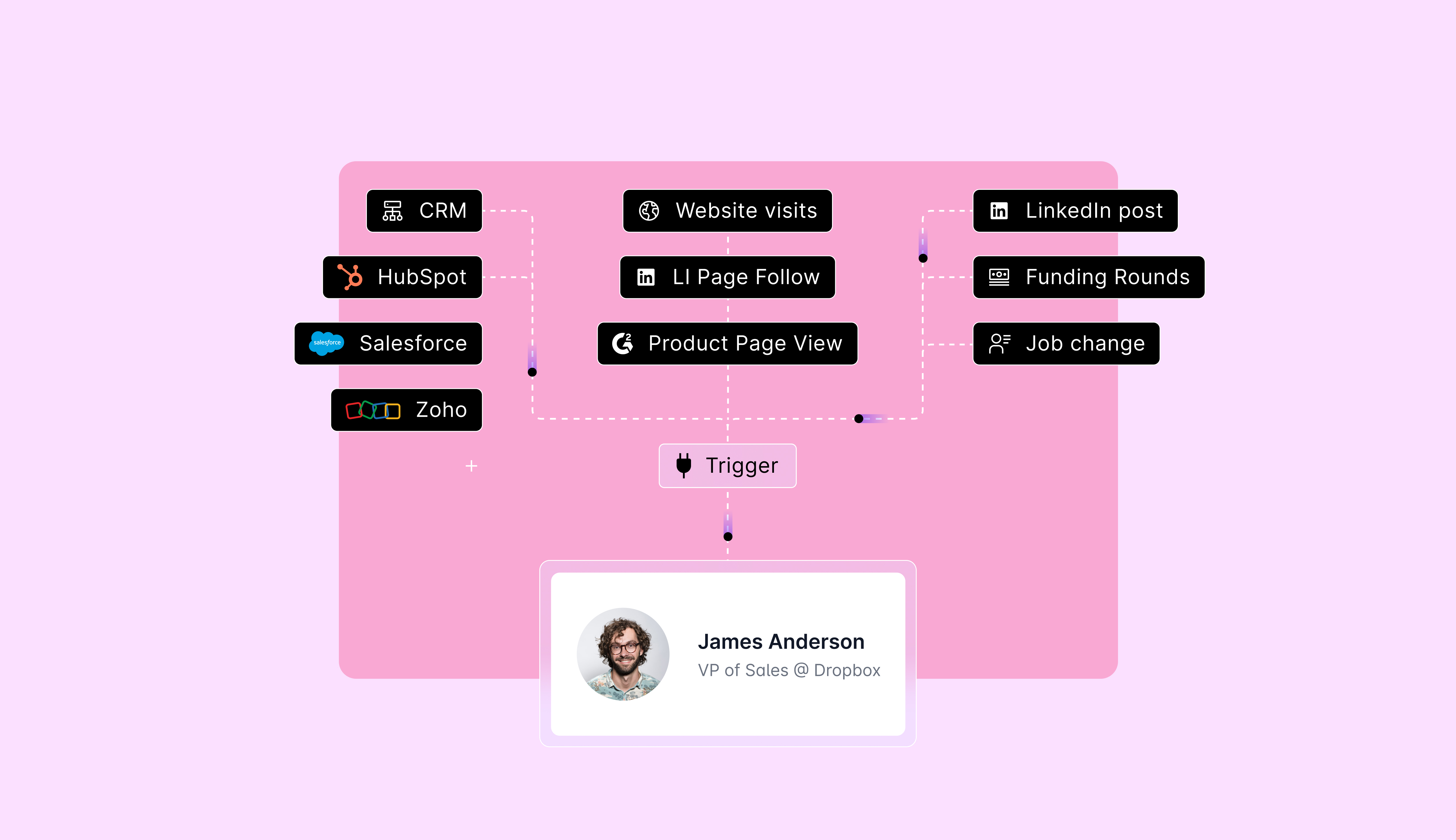
Common triggers include:
- Job and role changes: A prospect joins a new company, receives a promotion, or takes responsibility for a department that could benefit from your product.
- Funding announcements: A business secures investment that may support hiring, expansion, or technology purchases.
- Hiring activity: A company recruits for roles that suggest a growing operational need, such as additional sales representatives or revenue operations specialists.
- Executive appointments: A new leader reviews existing processes, evaluates suppliers, or sets departmental priorities.
- Company expansion: New offices, acquisitions, and entry into additional markets can create fresh requirements.
- Engagement signals: A prospect returns to product pages, discusses a relevant industry problem publicly, or begins comparing potential solutions.
Alta's glossary entry on selling signals explains how timing, prospect fit, and observable behavior can help determine when a sales team should initiate or intensify outreach.
The distinction between a trigger and a buying signal matters. A funding announcement is evidence of a company event, not proof that it intends to buy your product. A job change establishes that a person's circumstances have changed, but the new role may have nothing to do with your offering. The sales team still needs to assess relevance.
Job changes as a high-value signal
A job change can create an opportunity because it alters a person's responsibilities, relationships, and working environment. The commercial implications depend on the role, the organization they join, and their influence over purchasing decisions.
Consider a sales operations leader who previously evaluated your CRM automation product but could not secure funding at their former employer. Six months later, they join a growing software company in the same function. They already understand the problem your product addresses and may now have greater authority to evaluate potential solutions.
That combination provides a reasonable basis for renewed contact. The representative knows the contact's professional background, has context from the previous discussion, and can investigate whether the new company faces a similar problem.
A job change can create an opportunity in several ways.
- A former champion joins a new company. Someone who supported your product previously may be willing to introduce it to a new organization. Their familiarity can reduce the effort required to explain the category, though the new company must still have a relevant need and a viable purchasing process.
- A buyer takes on greater responsibility. A promotion may give a previous contact more influence over budget, suppliers, or departmental strategy. Their priorities may also change as they take responsibility for a broader team.
- A new leader reviews existing systems. Executives and department heads often assess current processes and suppliers as they establish priorities. Outreach that relates to their stated objectives may be useful during this period.
- A contact moves into a different function. A person who previously had little influence over purchasing may become responsible for a process your product supports.
Timing and context matter more than congratulating someone on a new position. A message that merely acknowledges a promotion has little commercial value unless it connects naturally to a relevant problem or professional priority.
Also, don't assume every new employee intends to replace existing systems. Large organizations may have long contracts, strict procurement policies, and limited department-level authority. A job change creates a reason to investigate, not permission to presume a purchase.
Funding, hiring, and other company-level triggers
Person-level events are only one part of signal-based selling. Company developments can reveal changes in capacity, priorities, and potential demand.
A funding announcement, for example, may indicate that a company has resources to pursue projects that were previously postponed. The type of funding matters, however. A small round intended to extend the company's runway does not necessarily mean it has a larger budget for software purchases.
Hiring can provide more specific context. An organization adding several sales development representatives may need better prospecting systems, training, or reporting capabilities. A company recruiting across multiple regions may require infrastructure to support a larger operation.
Acquisitions and geographic expansion can create different needs. Merging businesses may need to integrate their systems, standardize workflows, or consolidate suppliers. Entering a new market may introduce new compliance requirements or demand different commercial capabilities.
The representative should connect each event to a plausible business problem. A company's expansion alone is not sufficient reason to recommend a solution unrelated to its current priorities.
Forbes' September 2026 article on how AI is changing business development priorities</a> discusses how changing buyer behavior is making relevance and trust more important in business development. This is directly relevant to trigger-based outreach: the event provides an opening, but the message must still offer something useful.
Combining person-level and company-level events can strengthen the context. A newly appointed sales leader joining a company that has recently raised funding may present a more compelling opportunity than either signal alone, particularly if the business is also expanding its sales team.
Still, the signals should be verified independently. Combining several weak or outdated indicators does not automatically create a strong buying opportunity.
Building a workflow that catches signals in time
Signal-based selling becomes difficult to manage when representatives must manually discover every event. People change jobs daily, companies announce developments across different channels, and useful information can quickly lose relevance.
A structured workflow helps teams identify the right events, validate them, and decide what to do next.
First, define the signals that matter to your business. A vendor selling sales technology might prioritize new sales leaders, hiring growth in revenue teams, and relevant changes in a prospect's technology environment. Another business may focus on funding, acquisitions, or regulatory developments.
Next, establish a reliable source for each signal. Depending on the event, this could include public company announcements, professional profiles, job postings, news coverage, and appropriately licensed commercial data sources.
Then connect the information to your ideal customer profile. A job change should only enter an active campaign if the individual and their new organization meet the agreed targeting criteria. This prevents the team from spending time on every detected event.
A practical workflow includes:
- Detect the event: Identify a recent job change, promotion, funding announcement, hiring trend, or other relevant development.
- Verify the source: Confirm the event, the date, the person's current role, and the associated company.
- Assess the opportunity: Check account fit, previous CRM activity, existing relationships, and the likely relevance of the trigger.
- Choose the next action: Route the prospect to the right representative, prepare a personalized message, or hold the record for further research.
- Record the outcome: Track replies, meetings, qualification decisions, and opportunities created.
Alta's Audience feature supports prospect discovery and continuously refreshed audiences based on criteria that can include trigger events and other data sources. This type of capability can help keep prospect lists current as new people match the campaign requirements.
Automation should also account for signal freshness. A promotion announced yesterday may provide a useful opening, while an event from many months ago may no longer justify immediate outreach. Different triggers need different expiration windows, so teams should define them based on the event and the buying cycle.
Not every signal needs to trigger an automatic message. Some can create an alert for a representative to review, especially when the account is strategically important or the potential commercial consequences are significant.
Personalizing outreach around the trigger itself
The quality of trigger-based selling depends on how the representative uses the information. Mentioning an event without explaining its relevance produces the same generic outreach as a conventional sequence, only with a different opening sentence.
A useful message connects the event to a plausible business need.
For a former champion joining a new company, the representative might briefly acknowledge the new role and ask whether the previously discussed operational challenge is relevant in the new environment. The message should not assume that the person plans to purchase the same product again.
For a company expanding its sales team, the representative could explain how a relevant capability helps organizations manage a growing prospecting operation. The message should be grounded in the company's needs rather than making unsupported claims about what the expansion means for its budget.
AI can help by reviewing CRM history, researching the company, and drafting an opening that reflects the detected signal. Alta's article on reactivating closed-lost opportunities explores how previous deal context and new triggers can inform renewed outreach when circumstances change.
The representative should verify the information before sending the message. AI-generated research may include outdated job titles, confuse people with similar names, or infer a business need that hasn't been established. The system should make relevant evidence easier to use rather than encourage outreach based on speculation.
Avoid referencing every available signal. A message that mentions a person's new job, recent activity, company growth, and several other details can feel intrusive. One relevant observation is usually sufficient to establish why the conversation might be useful.
The aim is to make the timing and content of outreach more relevant, not to demonstrate how much information the sales team can collect.
Measuring whether signal-based selling works
Signal-based selling should be evaluated against commercial outcomes rather than the number of events detected.
Start by measuring the proportion of signals that lead to valid, qualified prospects. A high volume of job-change alerts means little if most contacts fall outside the target market or their new roles have no connection to the product.
Next, measure how effectively those prospects engage. Track positive reply rates, qualified meetings, opportunity creation, and progression through the sales pipeline. Compare performance by trigger type to identify which events are useful for your particular market.
For example, new leadership appointments may generate more meetings in enterprise accounts, while hiring signals may matter more to midmarket companies. The results will vary by product and audience, so avoid assuming that one trigger is universally superior.
Timing also deserves attention. Record the interval between the event and the first outreach attempt, then compare results across relevant groups. This can help determine how quickly different triggers should be acted on.
Finally, compare signal-based campaigns with a suitable baseline. If the team already contacts many of these accounts through its normal prospecting process, some resulting opportunities might have emerged without signal monitoring. A controlled comparison can help estimate the additional value the new workflow creates.
Frequently Asked Questions
Act while the event remains relevant, but do not prioritize speed over verification. A job change or promotion may justify outreach within days once the contact and role are confirmed. Some company-level triggers remain relevant longer. The appropriate window depends on the event, the buyer, and the sales cycle.
There is no universally best signal. A job change can be especially useful when a former champion joins a suitable company, while hiring, funding, or technology changes may matter more for other products. Compare positive replies, qualified meetings, and opportunity conversion by signal type to identify what works for your business.
Signal discovery, data enrichment, qualification rules, and campaign routing can be automated. However, important records and sensitive outreach may still warrant human review. Verification, data quality, privacy requirements, and message relevance should remain part of the process, even when the workflow runs automatically.