Top 11 AI Voice Agents for Lead Generation in 2026: A Comprehensive Review

Discover the best AI voice agents for lead generation in 2026. Compare features, use cases, and what to look for before you buy.
Leads contacted within the first five minutes of showing interest are 21x more likely to convert. The average B2B sales team responds in 42 hours.
That gap is why AI voice agents exist, and why adoption has accelerated dramatically in the past two years. If your team is still relying on human SDRs to handle every cold call and inbound qualification, you're not just slow. You're leaving pipeline on the table.
This guide covers the top AI voice agents built for lead generation in 2026: what they do, how they work, and what separates the ones worth using from the ones that sound good in a demo but fall apart in a real sales conversation.
What Are AI Voice Agents for Lead Generation?
AI voice agents for lead generation are automated systems that conduct sales conversations over the phone. They place outbound calls, qualify inbound leads, and book meetings without human involvement at every step. AI voice agents are different from voice AI companies who utilised ethically sourced voice data to amplify brands product offerings, marketing and customer interactions.
They're not IVR trees or robotic scripts. Modern AI voice agents use large language models to hold natural, responsive conversations. They can handle interruptions, answer off-script questions, and adjust based on what the prospect says.
In practice, an AI voice agent handles the early pipeline work your SDRs spend most of their time on: cold outreach, initial qualification, and appointment scheduling. The goal isn't to replace salespeople. It's to make sure the calls that reach your team are already worth taking.
For inbound leads, the value is even more immediate. An AI voice agent that responds in under 30 seconds (versus the industry average of 42 hours) changes the conversion math entirely.
Top 11 AI Voice Agents for Lead Generation in 2026
The tools in this category vary significantly in how they're built and what they're designed to do. Some are purpose-built for outbound prospecting. Others are stronger on inbound qualification. A few try to do both. Here's how the landscape looks.
1. Alta (Alex): Signal-Based AI Calling for Inbound and Outbound
Alta's AI calling agent Alex is built for revenue teams that need to act on signals, not just schedules.
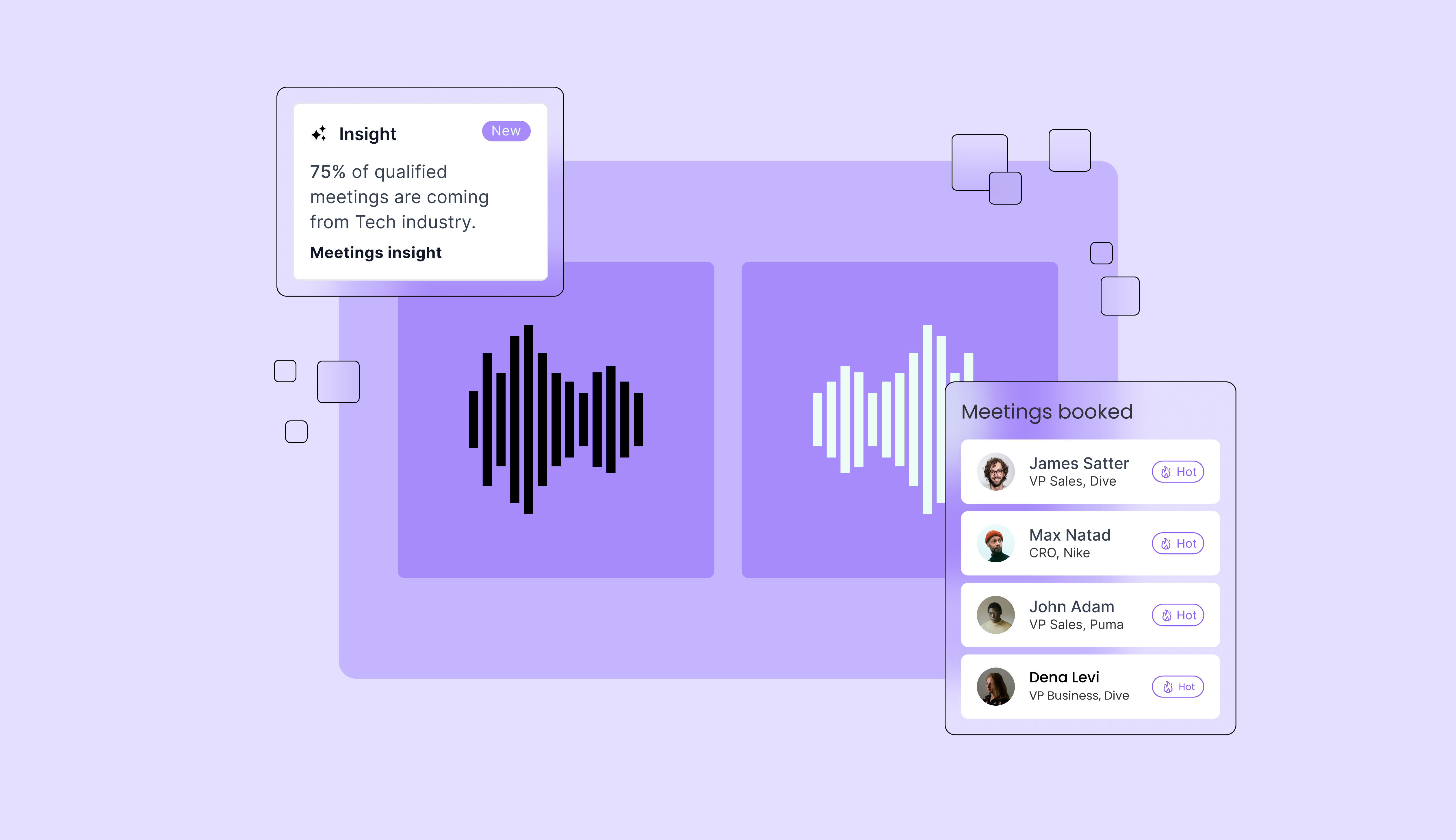
Alex handles both inbound qualification and outbound calling, responding to leads in under 30 seconds and conducting structured conversations designed to qualify and route. What separates Alex from most calling tools is the signal layer: Alex doesn't just call. It knows when to call and why, based on first, second, and third-party signals feeding into Alta's GTM system.
For inbound, Alex picks up where your web form left off. A prospect fills out a form, triggers a behavior on your site, or gets routed from an ad click. Alex calls within seconds, qualifies the lead based on your ICP criteria, and books a meeting directly into your sales rep's calendar.
For outbound, Alex works as part of a broader campaign workflow alongside Alta's AI SDR, Katie. The calling layer activates based on signal strength, reaching out when a prospect is most likely to engage.
Best for: Revenue teams running high-volume inbound qualification, or outbound campaigns where timing and personalization matter.
Key proof point: Under 30 seconds speed-to-lead; 3x more completed dials vs. human calling baselines.
2. Conversational Platform Builders (e.g., Retell AI, Vapi)
Developer-focused platforms that let you build custom AI voice agents from scratch. Strong on flexibility and telephony infrastructure; require engineering resources to deploy and maintain. Best for teams that want to build a proprietary calling workflow rather than use an out-of-the-box solution.
Best for: Product and engineering teams building custom calling experiences.
Watch out for: Setup complexity; no native CRM sync or GTM workflow out of the box.
3. AI Dialers with Basic Conversation (e.g., Twilio-based solutions)
Telephony-first tools that layer basic AI conversation on top of auto-dialing infrastructure. Solid for high-volume outbound at scale; conversation quality depends heavily on the LLM and script configuration. Better for low-complexity qualification than dynamic discovery conversations.
Best for: High-volume outbound where speed matters more than conversation depth.
Watch out for: Call quality degradation in non-scripted conversations.
4. Inbound-First Qualification Agents (e.g., Qualified, Drift Voice)
Designed primarily for inbound lead capture, often triggered from web activity. Routed conversations based on CRM data and firmographic filters. Strong on identifying hand-raise intent; lighter on outbound orchestration.
Best for: High-traffic inbound funnels with active SDR teams to hand off to.
Watch out for: Limited outbound capability; often requires significant CRM setup to work well.
5. AI Sales Development Platforms with Voice (e.g., Outreach, Salesloft AI)
Enterprise sales engagement platforms that have added AI voice capabilities. Calling is one feature among many; tight integration with existing sequencing and sales workflows is the main advantage. Less purpose-built for AI-first workflows.
Best for: Enterprise teams already on these platforms who want AI calling without adding a new vendor.
Watch out for: AI voice quality can lag behind purpose-built tools; often needs manual review to tune.
6. Standalone Cold-Calling AI (e.g., AiSDR, Artisan Voice)
Purpose-built for outbound cold calling. These tools focus on running high-volume prospecting campaigns with AI-generated scripts. Fast to launch; less sophisticated on signal-based timing or CRM routing.
Best for: Early-stage teams that need outbound coverage quickly with minimal setup.
Watch out for: Conversation quality varies; no signal layer to inform when or why to call.
7. Voice AI for SMB (e.g., GoHighLevel AI)
Accessible voice AI tools embedded in SMB-focused CRM and marketing platforms. Easier to set up; narrower in capability. Designed for appointment booking more than complex qualification.
Best for: Small businesses and agencies running appointment-based sales.
Watch out for: Not built for enterprise GTM workflows.
8. Healthcare and Industry-Specific Voice Agents
Vertical-specific voice tools trained on regulated conversation flows: patient intake, insurance qualification, compliance-aware scripts. Not a fit for general B2B lead gen but worth noting for relevant industries.
Best for: Healthcare, insurance, financial services. Watch out for: Poor fit outside their target vertical.
9. Multilingual AI Voice Agents
Tools optimized for cross-border outreach with native-sounding language support across multiple markets. Useful for global GTM teams but often sacrifice depth for breadth.
Best for: Global sales teams targeting non-English markets.
Watch out for: Conversation quality in low-resource languages can be inconsistent.
10. AI Receptionist Platforms (e.g., Synthflow, Air.ai)
Built to handle inbound call reception: answering calls, routing, and basic qualification. Strong on availability (24/7 coverage); lighter on proactive outbound or CRM-native workflows.
Best for: Teams that need 24/7 inbound coverage without adding headcount.
Watch out for: Not a substitute for a full outbound calling strategy.
11. Voice AI Inside CRM Ecosystems (e.g., HubSpot AI Calling, Salesforce Einstein Calling)
Native calling AI built into CRM platforms. The integration advantage is real; the AI capabilities are often behind what standalone tools offer. Best as a complement to a purpose-built voice agent rather than a replacement.
Best for: Teams that prioritize CRM-native workflows over AI capability depth.
Watch out for: Feature lag compared to purpose-built AI calling platforms.
Best Practices for Implementing AI Voice Agents
Getting results from AI voice agents isn't just about picking the right tool. How you deploy matters as much as what you deploy.
Start with one use case. Teams that try to automate inbound qualification and outbound prospecting simultaneously usually do neither well. Pick the higher-pain workflow first (typically inbound speed-to-lead) and prove value before expanding.
Define your qualification criteria before you launch. The AI is only as smart as the logic you give it. Know your ICP filters, disqualification signals, and handoff triggers before the first call goes out. Retrofitting these after launch is painful.
Keep humans in the loop at handoff. The best AI calling implementations don't try to run the entire deal cycle on autopilot. They hand off warm, qualified leads to human reps who have full context: call summary, qualification notes, and next steps ready when they pick up.
Audit call recordings regularly. AI conversations drift over time, especially as your ICP or product evolves. Build a review cadence into your ops workflow. Most teams that fall short of expectations stop listening to calls after week two.
Integrate with your CRM from day one. An AI voice agent that doesn't write back to your CRM creates a data silo immediately. Make sure activity logging, lead status updates, and meeting bookings sync automatically.
30-Day AI Voice Agent Implementation Timeline
A disciplined first month separates teams that see ROI from teams that quietly churn off the tool. Here's the week-by-week breakdown that works.
Week 1: Pre-launch preparation. Audit your CRM before anything touches it: dedupe records, fix lead status fields, and confirm routing rules actually reflect how your team works. Define your ICP filters, disqualification signals, and handoff triggers in writing. If your qualification criteria live in a rep's head, the AI can't use them.
Week 2: Technical setup. Connect the CRM with two-way sync and test it with dummy records before live data flows. Design the call flow: opening, qualification path, objection handling, booking, and the exit path for leads that don't fit. Run the compliance review now, not after launch (more on requirements below).
Week 3: Pilot launch. Deploy on one contained segment, one use case. Listen to every call in the first week; this is where you catch qualification logic that made sense on paper but stumbles with a real prospect. Tune prompts, criteria, and handoff rules daily.
Week 4: Scale-up and optimization. Expand volume and segments, compare results against the baseline you recorded pre-launch, and lock in a recurring call-audit cadence. By day 30 you should have a clear read on speed-to-lead, qualification rate, and meetings booked versus your old numbers.
This matches what we see across deployments: a basic workflow can go live in one to two weeks, and complex setups with custom qualification logic take four to six weeks to tune properly. The 30-day frame keeps a simple deployment honest without rushing a complex one.
What Are the Technical Requirements for Deploying AI Calling Software?
Before evaluating any vendor, confirm your own infrastructure can support the deployment. The checklist:
- CRM compatibility. Native two-way sync with your CRM, not a Zapier bridge. The agent needs to read lead status, write activity, and update stages without manual intervention.
- Telephony infrastructure. Dedicated phone numbers, carrier registration for outbound (unregistered numbers get flagged as spam), and call recording capability if you plan to audit, which you should.
- Compliance considerations. TCPA consent requirements for outbound calling in the US, do-not-call list scrubbing, call recording consent rules by state or country, and GDPR data handling if you touch EU prospects. Get legal sign-off on the call flow before launch, not after a complaint.
- Data prerequisites. Clean lead data with valid phone numbers, enrichment sources connected, and qualification fields defined in the CRM so the agent has somewhere to write its findings.
- Integration prerequisites. Calendar access for booking, routing rules for handoff, and a notification path (Slack, email, CRM task) so reps know a qualified lead is waiting.
Common Implementation Challenges and How to Solve Them
Most AI calling deployments hit the same four problems. All four are fixable.
CRM sync failures. Symptoms: duplicate records, activities logging to the wrong object, stale lead statuses. Fix: test field mappings with dummy data before launch, define deduplication rules explicitly, and assign one owner for sync health in the first month.
Call quality issues. Symptoms: robotic pacing, talk-overs, dropped context mid-call. Fix: audit recordings daily during the pilot, simplify call flows that try to do too much in one conversation, and pressure-test with off-script scenarios before scaling.
Qualification logic drift. Symptoms: the leads reaching reps slowly stop matching ICP. This happens when your market or product evolves but the agent's criteria don't. Fix: schedule a monthly criteria review, and treat every rep complaint about lead quality as a data point, not noise.
Handoff workflow breakdowns. Symptoms: qualified leads booked but reps show up without context, or leads sit unclaimed. Fix: require call summary, qualification notes, and next steps to transfer with every handoff, and set an SLA for rep follow-up on AI-booked meetings.
How Do You Measure ROI from an AI Voice Agent?
Measure against a baseline or you're measuring nothing. Record these before launch, then compare at 30, 60, and 90 days:
- Speed-to-lead: time from lead creation to first contact attempt. This is the metric with the clearest conversion link: leads contacted within five minutes are 21x more likely to convert, against a 42-hour B2B average.
- Connect and completion rates: dials that become conversations. AI calling pilots have driven 3x more completed dials and 40% faster time-to-first-touch versus human baselines.
- Qualification rate: the share of conversations producing a clear qualified-or-not outcome.
- Meeting booking conversion: qualified conversations that become held meetings, not just booked ones.
- Cost per qualified lead: total cost (platform, telephony, tuning time) divided by qualified leads produced, compared against your fully loaded SDR cost for the same output.
The benchmark question to answer by day 90: is the agent producing qualified pipeline at a lower cost per meeting than your previous motion, at equal or better quality? If yes, scale. If quality dropped, fix the qualification logic before adding volume.
7 Questions to Ask When Choosing an AI Voice Agent
Use this checklist when evaluating tools, before you sign anything.
- How does it handle off-script conversations? Ask to see a demo with an uncooperative or unpredictable prospect, not a best-case scenario.
- What's the speed-to-lead for inbound leads? If it can't respond in under two minutes, you're losing conversions.
- Does it integrate natively with your CRM? "Zapier integration available" is not the same as native sync.
- Can it qualify against your specific ICP criteria? Generic qualification logic won't map to your business without customization.
- How does it handle objections? Basic tools stall or repeat themselves. Strong tools acknowledge, pivot, and keep moving.
- What's the handoff workflow? Understand exactly how qualified leads get routed to your team and what data transfers.
- How does it learn from performance? One-time setup tools plateau quickly. Look for platforms that continuously improve based on call data.
The Right AI Voice Agent Pays for Itself in Pipeline
AI voice agents for lead generation have moved from early-adopter experiment to standard GTM infrastructure. The teams seeing results aren't those with the most sophisticated tech stack. They're the ones who picked a tool that fits their motion, deployed it with clear criteria, and stayed disciplined about measuring what moves.
The difference between a tool that books three meetings a week and one that books thirty usually comes down to timing and intelligence. Calling the right person, at the right moment, with the right context: that's the signal layer that separates AI calling from automated dialing.
Alex is Alta's answer to that problem: an AI calling agent that doesn't just dial, but acts on the signals that tell it when and why to call.
Want to see it in action? Book a demo and we'll show you what a signal-based calling workflow looks like on your pipeline.
Frequently Asked Questions
An AI voice agent for lead generation is an automated system that conducts phone conversations to qualify prospects and book sales meetings. It uses conversational AI to hold natural, responsive calls: asking qualification questions, handling objections, and routing high-intent leads to human sales reps. Unlike traditional auto-dialers, modern AI voice agents adapt to what the prospect says rather than following a rigid script.
The best AI voice agents respond to inbound leads in under 30 seconds. This matters because leads contacted within the first five minutes of expressing interest are 21x more likely to convert, and the average human sales team takes 42 hours to follow up. Speed-to-lead is one of the clearest ROI drivers for AI calling tools.
AI voice agents handle the high-volume, early-stage work that occupies most of an SDR's time: cold outreach, initial qualification, and appointment setting. They don't replace the human judgment required for complex discovery, negotiation, or relationship-driven deals. The best-performing teams use AI to handle qualification so human reps can focus on conversations that already show buying intent.
Most teams can launch a basic AI calling workflow in one to two weeks, assuming CRM integration and ICP criteria are defined upfront. More complex deployments (custom qualification logic, multi-channel orchestration, deep CRM sync) typically take four to six weeks to tune properly.
An AI SDR handles written outreach: emails, LinkedIn messages, and follow-up sequences. An AI voice agent handles phone conversations. Some platforms, like Alta, offer both as part of an integrated GTM system: an AI SDR (Katie) for outbound messaging and an AI calling agent (Alex) for phone qualification. Using them together reduces the gap between first touch and booked meeting.
Yes, but the use cases are distinct. For inbound, AI voice agents excel at speed-to-lead and qualification, catching leads while intent is high. For outbound, they're best suited to high-volume prospecting and early-stage qualification, where signal-based timing (knowing when to call) makes a significant difference in connect rates. The strongest platforms handle both within a single workflow.