Unlocking Outbound Sales Success: How Alta's Tools Can Transform Your Strategy in 2026

A practical guide to outbound sales automation in 2026. Learn how AI-powered tools improve personalization, deliverability, and pipeline — with real case studies.
Outbound sales hasn't gotten easier. Inboxes are more crowded, buyers are harder to reach, and the old playbook — blast a list, follow up three times, hope for a reply — doesn't produce pipeline the way it used to.
What's changed is the tooling. Outbound sales automation powered by AI can now handle personalization, timing, channel selection, and follow-up at a scale that manual SDR teams simply can't match. But automation alone isn't enough. The teams winning in 2026 aren't just sending more — they're sending smarter. This guide breaks down what that looks like, why it matters, and how to implement it.
What Is Outbound Sales Automation and Why Does It Matter in 2026?
Outbound sales automation is the use of software to execute and optimize prospecting workflows — from identifying target accounts and crafting personalized messages to sequencing multi-channel outreach and following up automatically.
It matters now more than ever because the economics of manual outbound are broken. SDR teams are expensive to hire, train, and retain. Ramp time eats into quota. And even experienced reps spend the majority of their day on tasks that aren't selling — researching prospects, writing emails, logging activity, switching between tools.
The shift in 2026 isn't about whether to automate outbound. It's about how intelligently you do it. The difference between automation that generates pipeline and automation that generates spam is personalization, timing, and feedback loops — exactly where AI makes the biggest impact.
How Can AI Improve Your Outbound Sales Strategy?
AI transforms outbound in three fundamental ways:
Personalization at Scale
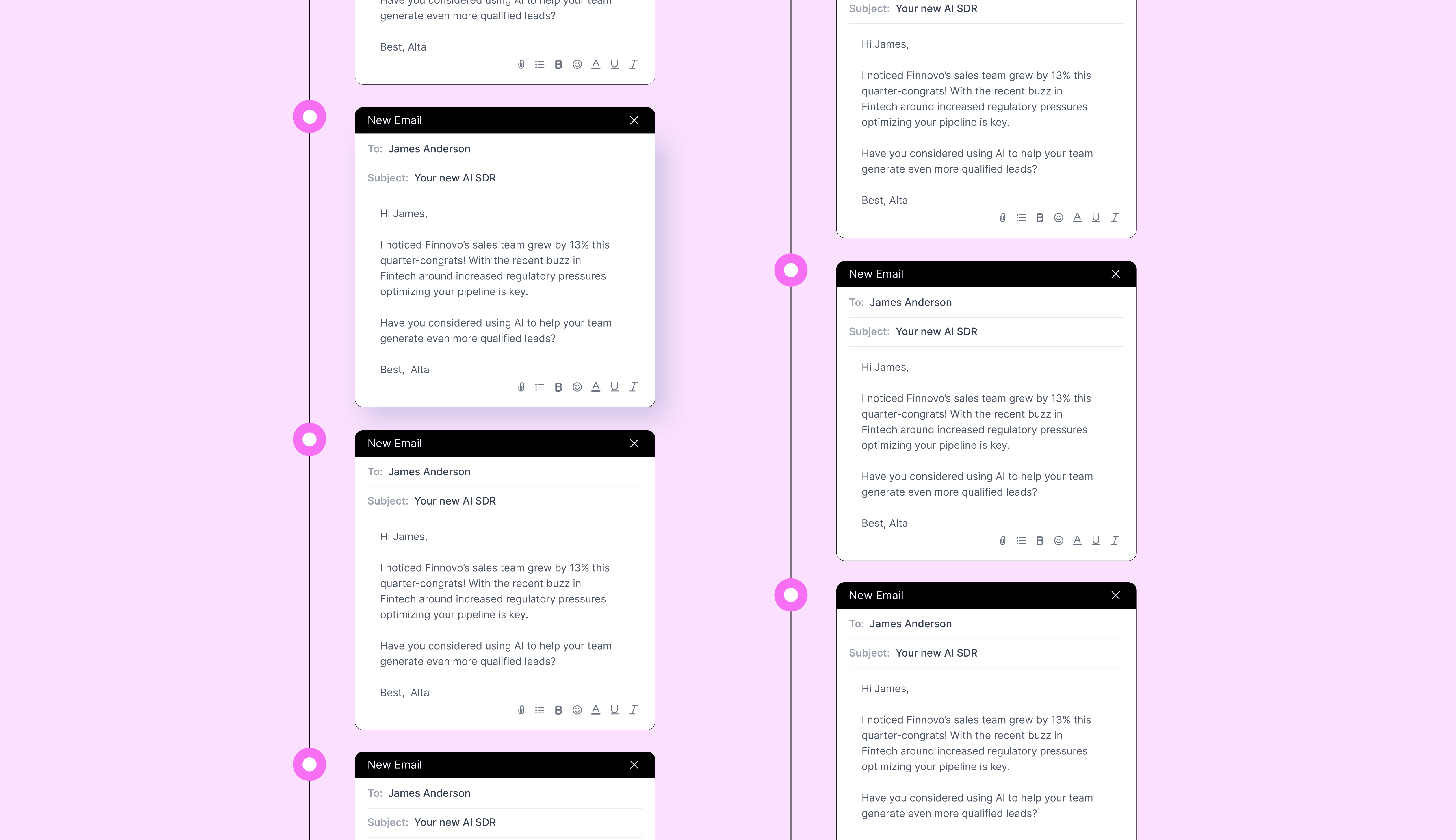
Traditional outbound forces a trade-off: personalize every message (slow, expensive) or send generic templates (fast, low conversion). AI email personalization eliminates this trade-off. AI agents can pull context from CRM data, LinkedIn profiles, company news, hiring signals, and past engagement to craft messages that feel 1:1 — at the volume of a mass send.
This isn't just inserting a first name and company. It's referencing a prospect's recent product launch, connecting it to a pain point they're likely experiencing, and offering a relevant solution — all generated automatically.
Intelligent Timing and Channel Selection
Not every prospect lives in their inbox. Some respond to LinkedIn DMs within hours but never open cold emails. Others prefer a phone call.
AI-powered outbound systems learn these patterns and adapt. If a prospect has ignored three emails but engages on LinkedIn, the system shifts. If call pickups spike on Tuesday mornings for a certain segment, outreach adjusts accordingly. No manual rules. Just data-driven channel selection.
Continuous Learning
The most underrated advantage of AI in outbound is the feedback loop. Every reply, every open, every objection feeds back into the system. Which messaging resonates with VP-level prospects? Which subject lines perform in financial services? Which call-to-action drives the most meetings?
A manual team might review this quarterly. An AI system adjusts daily.
What Makes Alta's Approach Different for Outbound Sales?
Most outbound tools automate individual tasks in isolation — a sequencer for email, a separate tool for LinkedIn, another for calling. Alta connects all of them into a single system where every channel informs every other channel.
Here's what that looks like in practice:
- Katie (AI SDR Agent) runs personalized outbound across email and LinkedIn — using each AE's profile to send connection requests, follow-ups, and messages that adapt based on engagement.
- Alex (AI Inbound Agent) qualifies every inbound lead in under 5 minutes via call or message — gathering deal context, asking discovery questions, and booking meetings automatically.
- Luna (AI Growth Agent) provides visibility into what's working — which campaigns drive pipeline, which messaging converts, and where to double down.
- 50+ native integrations connect Alta bidirectionally to your CRM (Salesforce, HubSpot), ad platforms, intent data providers, enrichment tools, and communication channels — so data flows in both directions and nothing lives in a silo. See the full integration list →
The result isn't just more activity. It's smarter activity where outbound and inbound intelligence feed into each other, and every interaction makes the next one better.
How Are Real Teams Using AI to Transform Outbound?
monday.com: Scaling Without Hiring
monday.com's SDR team needed to handle surging inbound sign-ups while keeping outbound pipeline growing. They deployed Alta's agents across the funnel — AI for instant inbound qualification, always-on LinkedIn outbound, and intelligent Enterprise routing.
- Outbound meetings per month: 120 → 180 (50% increase)
- Speed-to-lead: 17 minutes → under 5 minutes
- Time saved per Enterprise AE: 14 hours per week
- Headcount added: zero
Their SDR leadership described the agents as an extension of the team — booking meetings faster than a human SDR and giving each AE back half a day every week.
Mesh: Tripling Qualified Meetings
Mesh's sales team was losing opportunities to slow response times and manual outreach overhead. After deploying Alta, the impact was immediate.
- 72% decrease in response times
- 3x increase in qualified meetings
- 21 hours/week saved on manual outreach
The team got 20 hours a week back to focus on strategy and closing deals — while Alta handled the volume.
PayPal: 145% Pipeline Growth in 6 Months
PayPal's business operations team used Alta to drive efficiency across their sales motion. Within six months:
- 18% increase in team efficiency
- 145% growth in sales pipeline
The takeaway across all three: Alta didn't just automate outreach — it gave these teams the scale, speed, and intelligence to grow pipeline without growing headcount.
10 Essential Steps for Implementing Outbound Sales Automation
- Define your ICP clearly. Automation amplifies whatever you point it at. If your targeting is off, you'll scale bad outreach.
- Audit your current tech stack. Map every tool your team uses for outbound. Identify overlaps, gaps, and manual steps that AI can eliminate.
- Consolidate your data sources. Your CRM, intent data, enrichment tools, and engagement history should feed a single system — not six disconnected ones.
- Start with one motion. Don't automate everything at once. Pick your highest-volume, most repeatable outbound motion and automate that first.
- Set up email deliverability foundations. Warm your domains, authenticate with SPF/DKIM/DMARC, and monitor sender reputation before scaling volume.
- Build personalization into the system. Configure your AI to pull context from CRM fields, LinkedIn, company signals, and past engagement — not just name and title.
- Enable multi-channel from day one. Email alone isn't enough. Set up LinkedIn and calling alongside email so the system can route to the best channel per prospect.
- Define your hand-off rules. Decide when AI passes a lead to a human — by deal size, objection complexity, or engagement threshold. Clear hand-offs prevent dropped leads.
- Monitor and iterate weekly. Review reply rates, meeting rates, and objection patterns. Adjust messaging, targeting, and channel mix based on real data.
- Measure outcomes, not activity. Emails sent is vanity. Meetings booked and pipeline generated are the metrics that matter.
Start Building a Smarter Outbound Engine
The outbound playbook has changed. Volume without intelligence just creates noise. The teams generating real pipeline in 2026 are the ones using AI to personalize every touchpoint, respond faster than the competition, and learn from every interaction automatically.
Alta's AI agents handle outbound across email, LinkedIn, and calls — while feeding every signal back into smarter targeting and messaging. See what that looks like with your data — book a demo.
Frequently Asked Questions
Outbound sales automation uses software and AI to execute prospecting workflows at scale — identifying target accounts, personalizing outreach, sequencing multi-channel follow-ups, and qualifying leads without manual effort. The goal is to increase pipeline and sales efficiency while freeing reps to focus on closing.
AI improves outbound by personalizing messaging at scale, optimizing send timing and channel selection based on prospect behavior, and creating continuous feedback loops that refine targeting and copy automatically. Teams using AI-powered outbound typically see significantly higher reply rates and more qualified meetings with less manual work.
The best outbound tools in 2026 go beyond email sequencing. Look for platforms that combine AI email personalization with LinkedIn outreach, calling, and inbound qualification in a single system — so every channel informs every other. Alta's AI agents handle all of this natively, with built-in deliverability management and CRM sync.
Start with technical foundations: authenticate your domain with SPF, DKIM, and DMARC. Warm new sending domains gradually. Monitor sender reputation and bounce rates. Beyond the technical setup, keep list hygiene tight, avoid spam trigger words, and send personalized content — mailbox providers reward engagement and penalize mass generic sends.
Effective personalization goes beyond merge fields. Use AI to pull real-time context — a prospect's recent company news, hiring patterns, tech stack changes, or content engagement — and weave that into messaging that connects their situation to your solution. The best outbound feels like a relevant conversation, not a template.