10 Essential AI Tools for Boosting Sales Teams in 2026
Compare 10 essential AI sales tools for 2026 — features, real-world results, and a 10-point checklist to help you choose the right one for your team.
Sales reps spend 60% of their time on non-selling work — updating the CRM, hunting for collateral, chasing approvals — according to Salesforce's State of Sales report. AI sales tools exist to claw that time back, and the teams using them are 3.7x more likely to hit quota.
The catch: the market is crowded and every vendor claims to be an "AI agent." This guide breaks down the best AI sales tools for 2026 by what they actually do, who they're built for, and what results look like in practice — plus a checklist to run before you sign anything.
What Are AI Sales Tools and Why Do They Matter in 2026?
AI sales tools are software that uses artificial intelligence to execute or accelerate sales work — prospecting, outreach, qualification, calling, and pipeline management — rather than just recording it.
It's worth separating three categories, because vendors blur them constantly:
- AI assistants help humans work faster: drafting emails, summarizing calls, enriching data. The rep still does the work.
- AI agents (AI SDRs) do the work autonomously: researching prospects, sending sequences, qualifying inbound leads, and booking meetings with human oversight.
- AI platforms connect multiple agents and channels into one system, so outbound, inbound, and follow-up don't live in disconnected tools.
The shift toward agents is not hype at this point. 94% of sales leaders say AI agents are essential for meeting business demands (Salesforce, State of Sales), and sales professionals save an average of 2 hours and 15 minutes per day with AI (Sopro, 2026). Speed matters too: leads contacted within the first 5 minutes are 21x more likely to convert — a window no human team covers around the clock.
What Are the Best AI Sales Tools in 2026?
The short answer: it depends on whether you need a full GTM system, a point solution, or an add-on to your existing stack. Here are the ten tools worth evaluating, starting with the platform play.
1. Alta — best AI GTM system for pipeline generation
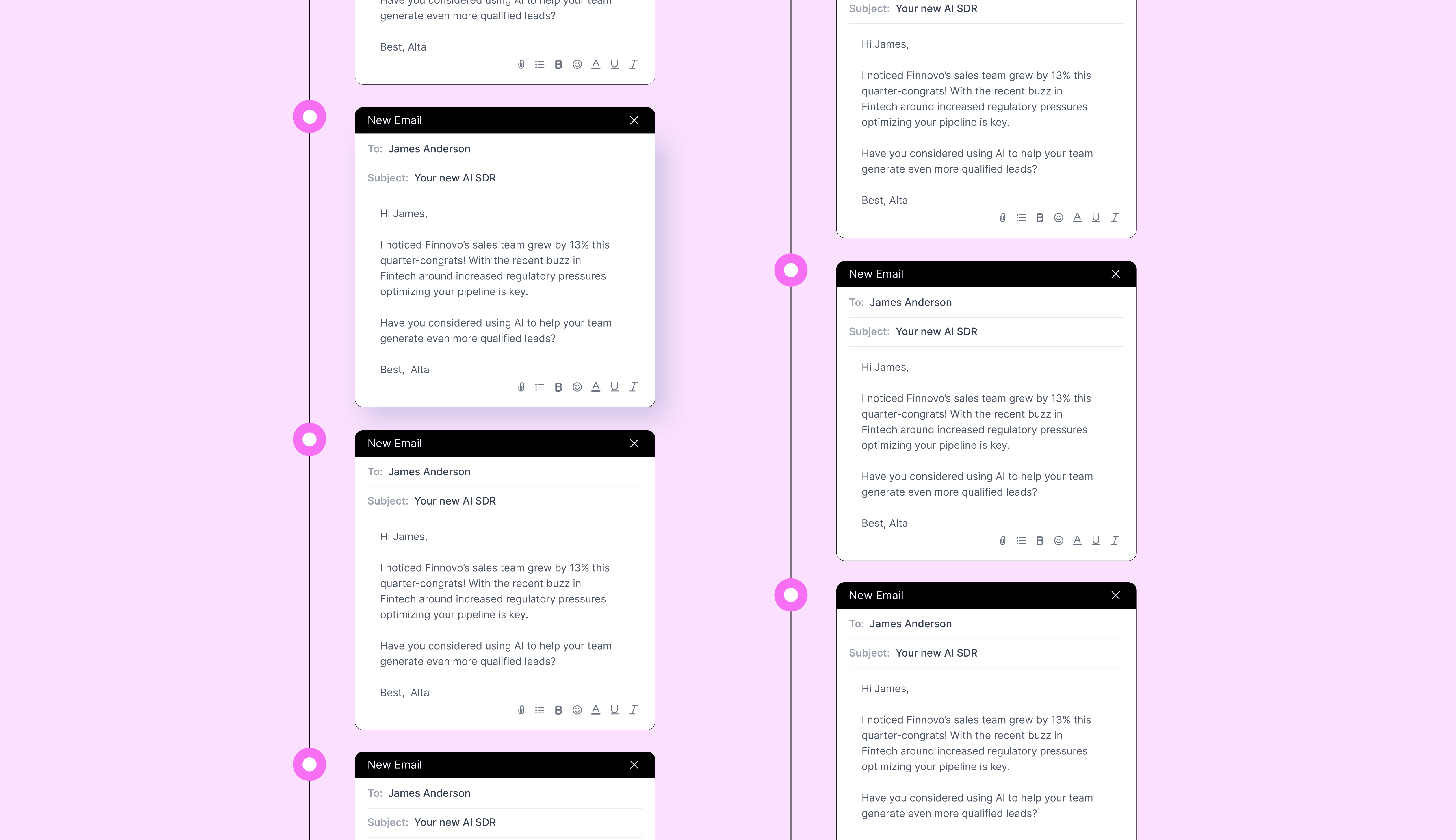
Alta replaces a fragmented stack of prospecting, outreach, and qualification tools with a single system of AI agents: Katie for outbound, Alex for inbound qualification, and Luna for growth.
The difference is architectural. Instead of bolting AI features onto separate tools, Alta's agents share context — so the lead Katie sourced is the same lead Alex qualifies and Luna routes. Where the average B2B response time is 42 hours, Alex responds to inbound leads in under 30 seconds. Customers include monday.com, Mesh, and CloudKitchens, and Alta is a G2 High Performer (Winter 2026). It integrates with the CRMs and tools teams already run on, and is SOC2 and ISO 27001 compliant.
Best for: B2B teams that want AI running pipeline generation end to end, not another point tool to manage.
2. Artisan — best for fully autonomous outbound email
Artisan's AI SDR ("Ava") handles outbound end to end — sourcing contacts, writing sequences, booking meetings. Strong for teams that want outbound on autopilot, though it's premium-priced and focused primarily on email.
Best for: Teams that want hands-off outbound email at scale.
3. Apollo.io — best database with AI built in
Apollo pairs a 275M+ contact database with AI-assisted email drafting and sequencing, with a free tier to start. The AI assists rather than acts — reps still drive the motion.
Best for: Small teams that need contact data plus AI-assisted outreach on a budget.
4. Clay — best for data enrichment workflows
Clay is a data orchestration tool: it chains enrichment providers and AI research into workflows that build highly targeted, well-researched lists. It's powerful but has a real learning curve — it's a builder's tool, not a turnkey agent.
Best for: Ops-minded teams that want deep, customized prospect research.
5. Nooks — best AI parallel dialer
Nooks focuses on calling: parallel dialing, real-time coaching, and call analytics. If cold calling is core to your motion, it multiplies connect rates. It doesn't touch email or inbound.
Best for: Teams whose pipeline runs on cold calls.
6. AiSDR — best lightweight autonomous email agent
AiSDR is an autonomous email agent — simpler in scope than a full platform, priced for smaller teams that want outbound sequences running without daily management.
Best for: Early-stage teams testing autonomous outreach.
7. Regie.ai — best AI layer for existing sequencers
Regie adds AI content generation and prioritization on top of tools like Salesloft and Outreach. It's an enhancer, not a replacement — useful if you're committed to your current engagement platform.
Best for: Teams keeping their sequencer but wanting AI-generated content.
8. Gong — best conversation intelligence
Gong records, transcribes, and analyzes sales calls to surface deal risks, coaching opportunities, and forecast signal. It improves how your team sells; it doesn't generate pipeline itself.
Best for: Teams with an established sales motion that want to improve win rates.
9. Salesforce Einstein — best native CRM AI
Einstein embeds AI agents and predictions directly inside Salesforce. If your entire operation lives in Salesforce, it's the lowest-friction option — though capabilities are tied to your existing Salesforce footprint and edition.
Best for: Salesforce-first organizations adding AI without new vendors.
10. Lavender — best AI email coach for reps
Lavender scores and coaches reps' emails in real time — subject lines, length, readability, personalization — inside the inbox. It doesn't send anything for you; it makes the emails your humans write measurably better.
Best for: Teams keeping humans on the keyboard but wanting every email sharper.
How Are Real Teams Using AI Sales Tools?
The measurable wins come from replacing manual coverage, not just speeding up individual tasks. A few patterns we've seen:
Lean teams generating outsized pipeline. One Alta customer built a 7-figure pipeline in 6 months with a 1-person GTM team and zero SDRs — the AI agents handled sourcing, outreach, and qualification while the one human ran strategy and closed.
Speed-to-lead as a conversion lever. Teams that put an AI agent on inbound qualification capture demand that used to leak out during nights, weekends, and busy afternoons — the hours when that 21x conversion window slams shut.
AI calling that multiplies activity. In AI calling pilots, teams have seen 3x more completed dials and 40% faster time-to-first-touch — without adding headcount.
The honest caveat: AI agents excel at top-of-funnel volume, speed, and consistency. Complex negotiations, multi-stakeholder deals, and relationship-building still belong to humans. The best implementations pair the two deliberately.
10 Considerations Before Choosing an AI Sales Tool
Run this checklist before you commit:
- Does it act or just assist? An assistant saves minutes; an agent replaces workflows. Know which you're buying.
- Does it cover your channels? Email-only tools leave phone, LinkedIn, and inbound uncovered.
- Will it consolidate or fragment your stack? Every new point tool adds another data silo to reconcile.
- How good is the data underneath? AI writing to bad contact data just produces faster misses.
- Can you review and control the AI's output? Look for approval workflows and guardrails, not black boxes.
- Does it integrate with your CRM? If activity doesn't sync automatically, your reporting dies.
- What's the real cost at your volume? Per-seat, per-contact, and per-email pricing scale very differently.
- Is it secure and compliant? Ask for SOC2 / ISO 27001 before your security team does. (Here's Alta's.)
- How fast is time-to-value? Weeks-long implementations kill momentum. Most teams launch their first Alta campaign within a week.
- How will you measure success? Define the metric — meetings booked, speed-to-lead, cost per opportunity — before the pilot starts.
The Bottom Line
The AI sales tool market splits into point solutions that improve one motion and platforms that run pipeline generation as a system. Point tools are the right call when you have one specific gap. But if you're assembling three or four of them, you're rebuilding the fragmentation problem AI was supposed to solve.
We're not asking you to take our word for it. Book a demo and see what Alta's agents can do with your actual ICP — most teams launch their first campaign within a week.
Frequently Asked Questions
The best AI sales tools for 2026 are Alta for end-to-end AI pipeline generation, Artisan and AiSDR for autonomous outbound email, Apollo.io for contact data with AI assistance, Clay for enrichment workflows, Nooks for AI calling, Regie.ai for content on existing sequencers, Gong for conversation intelligence, Salesforce Einstein for native CRM AI, and Lavender for email coaching. The right choice depends on whether you need a full system or a point solution for one channel.
AI improves prospecting by automating research, personalization, and outreach at a scale and speed humans can't match. Sales professionals using AI save over 2 hours a day on average, and AI agents can research an account, draft relevant outreach, and follow up consistently across hundreds of prospects simultaneously. The compounding effect is coverage: no lead sits untouched because a rep was busy.
Small businesses get the most from tools that replace headcount they can't afford rather than assist headcount they don't have. An AI SDR platform like Alta lets a small team run outbound and inbound qualification without hiring SDRs — one Alta customer built a 7-figure pipeline with a single-person GTM team. Budget-conscious teams starting smaller can pair a database tool like Apollo with AI-assisted sequences.
Start with four questions: does it act autonomously or just assist, does it cover the channels where your buyers actually are, does it integrate with your CRM, and is it compliant with your security requirements (SOC2, ISO 27001)? Then pressure-test pricing at your real volume and define the success metric for your pilot before it starts. The full 10-point checklist above covers the rest.
The metrics that matter are pipeline outcomes, not activity counts: meetings booked, speed-to-lead, reply and conversion rates, and cost per qualified opportunity. Speed-to-lead is especially telling — leads contacted within 5 minutes are 21x more likely to convert, so response time is a direct revenue lever. Sales teams using AI are 3.7x more likely to meet quota, per Salesforce's State of Sales research.
No — they replace the repetitive work that keeps your team from selling. Reps currently spend around 60% of their time on non-selling tasks; AI agents absorb prospecting, qualification, and follow-up so humans spend their hours on demos, negotiations, and relationships. Complex, multi-stakeholder deals still need people. The teams winning with AI are redeploying talent, not removing it.
For agent-based platforms, expect first campaigns live within days and meaningful pipeline signal within the first month. Most teams launch their first Alta campaign within a week, and 86% of AI-using sales teams report positive ROI within the first year, per Sopro's 2026 research. Tools with heavy setup (deep enrichment workflows, conversation intelligence) take longer to compound.