Enhancing Sales Performance with AI Agents: A Comprehensive Guide for 2026

Learn how AI agents in sales improve performance, with a step-by-step implementation guide, common challenges, and a practical 8-step checklist for 2026.
Most sales teams don't have a talent problem. They have a capacity problem. Reps spend the majority of their week on research, data entry, and follow-up instead of selling, and pipeline suffers for it. AI agents in sales change that math by handling the repetitive work autonomously, so your team spends its hours on conversations that close.
This guide covers what AI agents actually do in a sales process, a step-by-step framework for implementing AI in sales, the challenges you should plan for, and a practical checklist to get started.
What Are AI Agents in Sales?
An AI agent in sales is software that performs sales tasks autonomously, from researching prospects to writing outreach to qualifying inbound leads, without waiting for a human to trigger each step. Unlike traditional sales automation, which executes fixed rules you configure in advance, AI agents interpret signals, make decisions, and learn from every interaction.
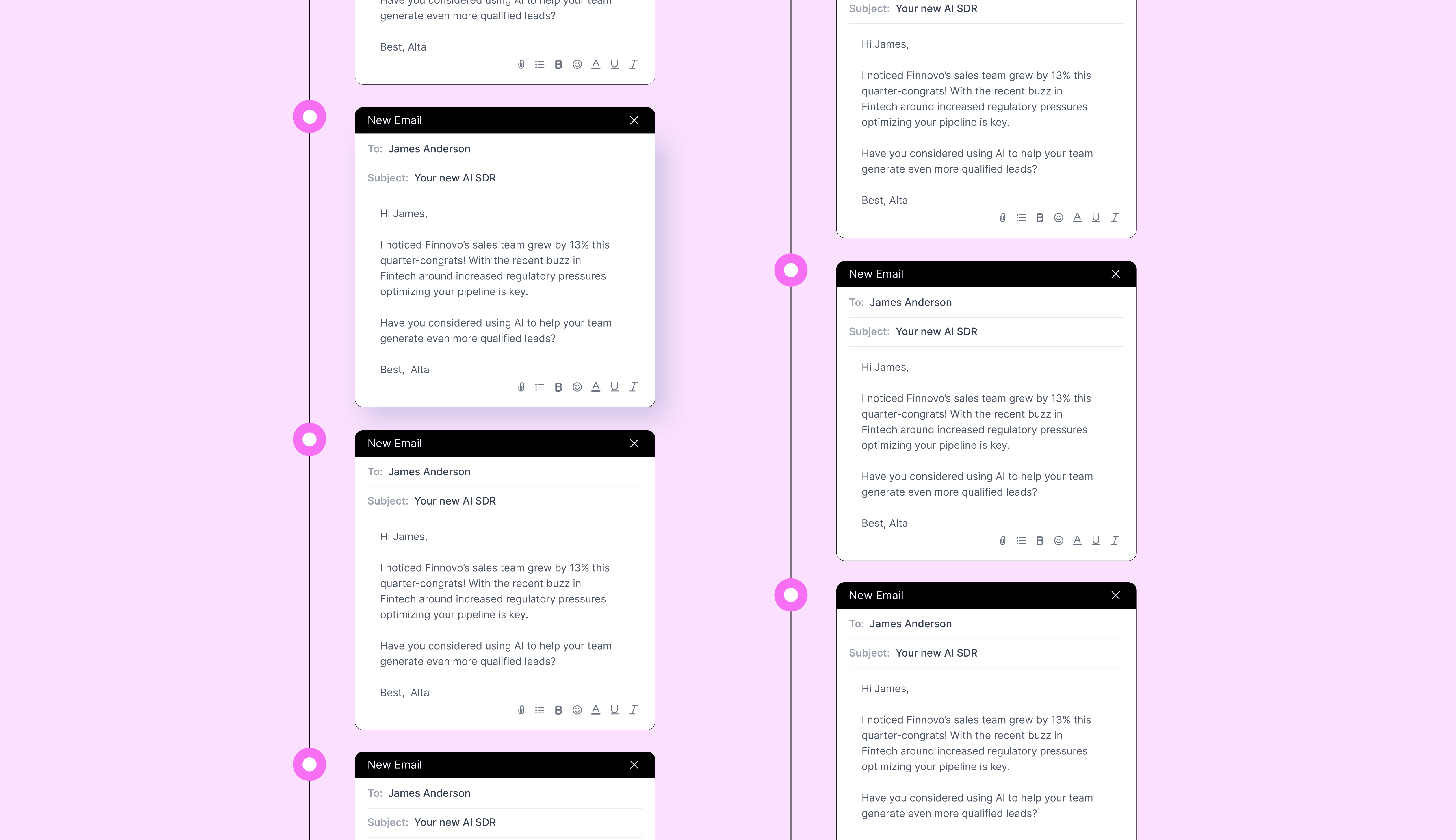
The category has evolved fast. Early sales AI meant chatbots and email sequencers. Today's agents handle complete workflows: an AI SDR can identify accounts showing buying intent, research the right contacts, and run personalized multichannel outreach end to end. An AI inbound agent can respond to a demo request, qualify the lead, and book the meeting before a human rep has opened their inbox.
The benefits show up in three places:
- Speed. The average B2B company takes 42 hours to respond to an inbound lead. Leads contacted within the first 5 minutes are 21x more likely to convert. Agents close that gap; Alta's inbound agent Alex responds in under 30 seconds.
- Capacity. Teams using AI agents report saving around 21 hours per rep per week on manual prospecting and admin work.
- Quality at scale. Personalization that once took 20 minutes per prospect happens automatically. Across 2M+ prospects, AI-personalized outreach generated 3.5x more email replies than templated sends.
One concrete example: a company built 7-figure pipeline in 6 months with a 1-person GTM team and zero SDRs by running outbound entirely through AI agents.
How Do You Implement AI Agents in Sales? A Step-by-Step Guide
Implementing AI in sales works best as a structured rollout: assess your process, choose the right agent, integrate it with your stack, train your team, then measure and optimize. Here's each step in practice.
Step 1: Assess your current sales processes
Map where your team's time actually goes. Look for high-volume, repetitive work: list building, lead research, first-touch outreach, inbound response, meeting scheduling, CRM updates. These are the tasks AI agents absorb first. Also measure your baseline metrics now (response time, meetings booked per rep, reply rates) so you can prove impact later.
Step 2: Choose the right AI agent for your sales objectives
Match the agent to the bottleneck. If pipeline generation is the problem, prioritize an outbound agent. If inbound leads go cold before anyone follows up, start with inbound qualification. Evaluate candidates on three criteria: compatibility with your existing systems, the data sources the agent can draw on (Alta's agents pull from 50+ data sources), and whether it improves from your team's feedback rather than running static playbooks.
Step 3: Integrate and deploy
Connect the agent to your CRM, email, calendar, and communication tools so it works inside your existing workflow rather than beside it. Check the vendor's integration coverage before committing. Start with a contained deployment: one segment, one use case, clear guardrails on what the agent can do autonomously and what requires human approval.
Step 4: Train and onboard your team
The biggest implementation failures are human, not technical. Show reps what the agent handles and, just as important, what it hands off to them. Set a feedback rhythm in the first weeks: reps review agent-written outreach and qualification decisions, and that feedback tunes the system. Position the agent as added capacity for the team, because that's what the time savings actually buy.
Step 5: Monitor and optimize
Track the agent's output against your baseline: response times, reply rates, qualified meetings, pipeline created. Review messaging quality weekly at first, then monthly. Expand the agent's scope as trust builds. Teams that follow this loop typically see results compound; Alta customers report 3x more qualified meetings after rollout.
The framework is one thing. Here's what AI agents in sales look like deployed against specific revenue problems, with the right agent matched to each bottleneck.
SaaS: Inbound Lead Qualification
The problem. A SaaS team generates more demo requests than reps can work, and the best leads cool off before anyone reaches them. The average B2B company takes 42 hours to respond to inbound. By then, intent has moved on.
What the agent does. An AI inbound agent like Alex responds in under 30 seconds, qualifies each lead against your ICP criteria, and books the meeting on the right rep's calendar. Every request, day or night, no triage queue.
The result. Leads contacted within the first 5 minutes are 21x more likely to convert, and Alta customers report 72% faster lead response after rollout.
Why it works. Speed compounds. Every minute saved at first touch is a minute the lead is still paying attention.
Manufacturing: Account-Based Outreach
The problem. Enterprise manufacturing deals involve many stakeholders and long research cycles. A rep can personalize outreach to a handful of accounts a week, not hundreds.
What the agent does. An AI SDR like Katie researches target accounts across 50+ data sources, identifies the right contacts, and runs personalized multichannel sequences to each stakeholder. That's the research-heavy work that never scaled by hand.
The result. Across 2M+ prospects, AI-personalized outreach generated 3.5x more email replies than templated sends.
Why it works. Personalization at volume is a capacity problem, and capacity is what an agent adds.
E-commerce & Retail Tech: Re-engaging High-Intent Accounts
The problem. In B2B e-commerce and retail tech, plenty of accounts show buying intent (pricing-page visits, repeat product views, a started-then-abandoned signup) and then go quiet before sales ever reaches out.
What the agent does. Luna watches those signals and triggers timely, personalized follow-up through Katie the moment intent appears, so a cooling account gets a relevant touch instead of a generic drip.
The result. Alta customers report 3x more qualified meetings after rollout, because intent acted on while it's fresh converts at a rate cold outreach never matches.
Why it works. A signal is only valuable while it's warm. An agent acts on it in real time. A human queue doesn't.
Professional Services: Reactivating Dormant Leads
The problem. Services firms sit on lists of past inquiries and lapsed opportunities that no one has time to systematically work.
What the agent does. Katie re-engages dormant contacts with context-aware outreach and routes anyone who responds to a human. A stale list turns into live conversations without added headcount.
The result. Teams using AI agents save around 21 hours per rep per week on prospecting and admin, hours that can go to the responses worth a human's attention.
Why it works. The work is high-volume and repetitive, which is exactly what an agent absorbs first.
High-Volume Verticals: Lead Nurturing at Scale
The problem. When lead volume runs into the hundreds, manual nurturing breaks down and prospects fall through the gaps between touches.
What the agent does. Agents keep every lead in motion with timely follow-ups, multichannel sequencing, and automatic CRM updates, so no prospect goes cold for lack of a next step.
The result. One company built 7-figure pipeline in 6 months with a 1-person GTM team and zero SDRs by running this motion through agents. For calling-led nurture, AI pilots show 3x more completed dials and 40% faster time-to-first-touch.
Why it works. Consistency at volume is mechanical work, and agents never skip a follow-up.
What Challenges Should You Expect When Deploying AI Agents?
The three most common obstacles are team resistance, data privacy concerns, and integration issues. All three are solvable with planning.
Resistance to change. Reps worry agents will replace them. Address it directly: agents take over the work reps already resent, and the goal is more selling time per rep. Involve your top performers in the pilot so adoption spreads from credible voices.
Data privacy and security. Sales agents touch customer data, so vendor diligence matters. Require SOC 2 and ISO 27001 compliance, clear data processing terms, and transparency about how your data is used. Review the vendor's security posture before signing.
Technical and data quality issues. Agents are only as good as the data they act on. Clean your CRM before deployment, define lead routing rules explicitly, and keep a human approval layer on outbound messaging until quality is proven. Worth being honest here: AI agents are not suited to complex negotiations or nuanced enterprise deals. Keep humans on the judgment calls.
Practical Checklist: 8 Steps to Implement AI Agents in Sales
- Audit your sales process and identify the highest-volume repetitive tasks.
- Record baseline metrics: response time, reply rates, meetings booked per rep.
- Define one primary objective for the agent (outbound pipeline, inbound speed, or rep productivity).
- Shortlist vendors on integrations, data depth, security certifications, and learning capability.
- Run a contained pilot with one segment and clear autonomy guardrails.
- Train the team on the human-agent handoff and set a feedback rhythm.
- Compare pilot results against baseline after 30 days.
- Expand scope gradually as quality and trust are established.
The Bottom Line on AI Agents and Sales Performance
Sales performance optimization in 2026 is less about pushing reps harder and more about removing the work that was never a good use of their time. AI agents in sales handle the research, outreach, and qualification volume that human teams can't sustain, and they respond at a speed no human team can match.
Start small, measure honestly, and expand what works. If you want to see what that looks like with your own pipeline, book a demo with Alta. Most teams launch their first campaign within a week.
Frequently Asked Questions
An AI agent in sales is autonomous software that executes sales tasks such as prospect research, personalized outreach, inbound lead qualification, and meeting booking without manual triggers. It differs from traditional automation by making decisions based on live signals and improving from feedback over time. Modern agents handle complete workflows rather than single tasks.
As of right now no - AI does not replace human sales reps, it replaces the repetitive work that slows them down. AI agents handle tasks like dialing, qualifying, following up, and logging data, while humans focus on strategy, relationship-building, negotiation, and closing. In most teams, the highest-performing model is hybrid: AI does the heavy lifting at the top of the funnel, and humans take over when judgment, trust, or complex decision-making is required.
Initial deployment is fast: most teams using Alta launch their first campaign within a week. A full rollout, including team onboarding, feedback loops, and scope expansion, typically runs 30 to 90 days. The pace depends mostly on CRM data quality and how quickly your team establishes a review rhythm.
Compare post-deployment metrics against your pre-deployment baseline. The core measures are lead response time, reply rates, qualified meetings booked, pipeline created, and hours saved per rep. As reference points, Alta customers report 3x more qualified meetings and 72% faster lead response after rollout.
They can be, if the vendor meets enterprise security standards. Look for SOC 2 and ISO 27001 compliance, clear data processing agreements, and transparency about how your data trains the system. Alta maintains both certifications; details are on the trust page.
Start with inbound lead response and qualification, because speed directly drives conversion: leads contacted within 5 minutes are 21x more likely to convert. Outbound prospecting is the strongest second candidate, since research and personalization consume the most rep hours. Save complex, judgment-heavy work for humans.