Are AI-Powered BDRs the Future of Sales or Just a Fad?
.png)
Explore how AI-powered BDRs are transforming sales development, automating outreach, qualifying leads, and helping teams generate more pipeline.
Sales development is undergoing one of the biggest transformations in decades.
Buyers today expect fast responses, relevant messaging, and engagement across multiple channels. At the same time, sales teams face rising customer acquisition costs, increased competition, and growing pressure to generate pipeline with limited headcount.
This is why AI-powered BDRs (Business Development Representatives) are becoming one of the most discussed topics in the Sales space.
AI BDRs automate prospecting, qualify leads faster, and scale outbound outreach across channels like email, LinkedIn, phone, and SMS. But as with any new technology, the question many sales leaders ask is:
Are AI BDRs the future of sales development - or simply another automation trend?
The reality is that AI BDRs are not replacing human sales professionals. Instead, they are reshaping how go-to-market teams operate by automating repetitive operational tasks and enabling human sellers to focus on the conversations that actually drive revenue at scale.
In this article, we explore what AI BDRs are, how companies are using them today, the real operational benefits they deliver, and what the future of AI in sales development looks like.
What Are AI-Powered BDRs?
An AI BDR is is designed to automate many of the tasks traditionally handled by human sales development representatives.
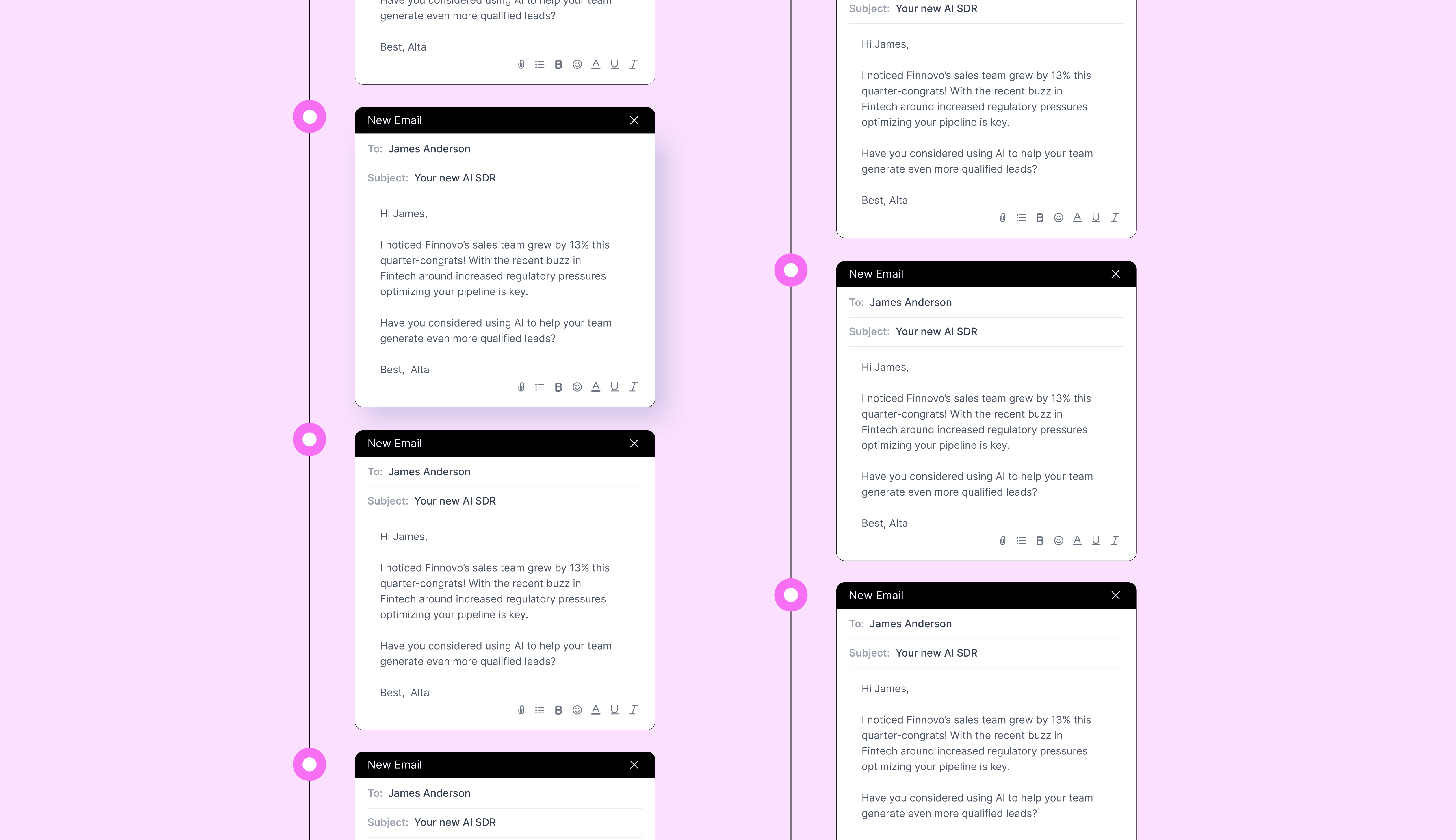
These tasks include prospect research, outreach execution, lead qualification, follow-up management, and meeting scheduling.
Instead of manually performing these activities, AI systems use machine learning, automation workflows, and large language models to run sales development processes at scale.
In traditional sales teams, BDRs spend much of their time researching prospects, crafting outreach messages, and managing follow-ups. While these activities are necessary, they often consume the majority of a rep’s time and limit the number of prospects a team can realistically engage.
AI BDR platforms transform this workflow.
Rather than manually executing every step, AI can automatically identify potential prospects, enrich their company data, launch outreach campaigns, and coordinate engagement across channels.
This allows sales teams to move away from manual prospecting and toward a systematic pipeline generation engine.
Traditional BDR vs AI BDR: Understanding the Difference
To fully understand the impact of AI in sales development, it is important to look at how traditional BDR workflows differ from AI-driven systems.
In a traditional model, prospect research is a manual process. Reps often spend hours reviewing LinkedIn profiles, company websites, and databases to gather basic information before initiating outreach. Messages are typically sent one prospect at a time, which limits the scale of outbound campaigns.
Because of this manual execution, outreach capacity is inherently constrained. Even the most productive sales reps can only engage with a limited number of prospects each day while maintaining personalization.
AI BDR systems change this dynamic by automating the operational layer of sales development.
Instead of manually researching prospects, AI can automatically enrich data using multiple sources. Campaigns can be launched across thousands of prospects simultaneously while maintaining personalized messaging and timing.
AI systems also coordinate outreach across multiple channels such as email, LinkedIn, phone calls, and SMS, ensuring consistent engagement while still maintaining personalised and researched messaging.
Some of the key differences between traditional and AI-driven sales development include:
- Traditional BDRs rely on manual prospect research, while AI systems automate data enrichment and targeting.
- Human reps typically send outreach sequentially, while AI can execute campaigns across thousands of prospects simultaneously.
- Outreach capacity is limited for human reps but scalable for AI-powered systems.
- Traditional campaigns require continuous management, while AI-driven workflows operate automatically once configured.
The result is not a replacement of sales teams, but a shift in how organizations allocate time and resources.
AI handles the operational execution layer, while human sellers focus on strategic conversations and closing deals.
How Companies Are Using AI BDRs Today
AI-powered sales development is already being adopted across industries as organizations look for more efficient ways to generate pipeline. The patterns below show how AI BDR implementation plays out in different contexts — from lean startups to enterprise account-based motions.
SaaS and Technology Teams
For B2B software companies, the most common pattern is multi-channel outbound at a scale small teams can't reach manually. Consider a three-person sales team manually working a few hundred prospects a month. With AI handling research, sequencing, and follow-up across email, LinkedIn, and phone, that same team can engage several times the volume while keeping messaging personalized — shifting their own time from prospecting to running demos and closing. The measurable wins here are usually higher reply rates from coordinated multi-channel outreach and a meaningful jump in qualified meetings booked, without adding headcount.
Professional and Financial Services
Services firms tend to use AI BDRs to standardize lead qualification for higher-consideration deals. Instead of reps spending hours qualifying inbound interest, AI runs structured qualification — surfacing decision authority, budget range, and project timeline through sequenced questions — before a human ever gets involved. The payoff is twofold: reps reclaim qualification time, and lead quality becomes more consistent because every prospect is scored against the same criteria. This is where lead qualification metrics matter most: tracking qualification accuracy and rep time saved shows the real ROI, beyond raw volume.
Manufacturing and Account-Based Motions
For manufacturers and other companies running account-based strategies against a defined target list, AI BDRs shine at signal monitoring and fast response. The system can watch a set of target accounts for buying signals — leadership changes, expansions, relevant news — and trigger personalized, timely outreach automatically. In motions where deals are large and timing is everything, this consistency is the value: no signal goes unnoticed, and no follow-up gets dropped. The relevant sales automation ROI measure here is pipeline influenced over time, not weekly activity counts.
Across all three, the through-line is the same: AI handles the operational execution layer — multi-channel outreach results improve through consistency and scale — while human sellers focus on the strategic conversations that close.
Real Results from AI-Driven Sales Development
Organizations implementing AI-powered sales development often see measurable improvements in pipeline efficiency.
While results vary depending on the company and industry, common outcomes include:
- Higher reply rates due to multi-channel outreach strategies
- Faster lead qualification and response times
- Increased meeting booking rates
- Significant time savings for sales teams
Many organizations report that AI BDR automation allows their sales reps to reclaim 10–20 hours per week previously spent on manual prospecting tasks.
This additional time can then be invested in higher-value activities such as product demos, account development, and closing deals.
Ultimately, AI improves both speed and scale, two of the most important factors in modern outbound sales.
How to Know If Your Company Is Ready for AI BDRs
Not every organization is immediately ready to adopt AI-powered sales development.
Before implementing AI systems, companies should evaluate whether their go-to-market structure can support automation.
Some key questions to consider include:
- Do you have a clearly defined Ideal Customer Profile (ICP)?
- Are your outbound campaigns already structured and tested?
- Is your CRM configured and integrated with your sales tools?
- Do you have reliable prospect data sources?
- Does your sales team have the capacity to handle additional meetings?
If the answer to most of these questions is yes, AI BDR platforms can significantly amplify your sales motion.
AI BDR Implementation Checklist
For organizations considering AI sales automation, the following steps can help ensure a successful rollout.
First, define your ideal customer profile and targeting criteria. Clear targeting ensures the system focuses on the right prospects rather than simply increasing outreach volume.
Second, build a multi-channel engagement strategy that combines email, LinkedIn, phone outreach, and other communication channels.
Third, integrate your AI system with existing sales infrastructure such as HubSpot or Salesforce so that data flows seamlessly across platforms.
Finally, continuously monitor performance metrics such as reply rates, meeting conversion rates, and pipeline generation to optimize campaigns over time.
Are AI BDRs the Future of Sales?
AI BDRs are not a temporary trend.
They represent a broader shift toward AI-assisted go-to-market systems where automation, data signals, and intelligent workflows work together to generate pipeline more efficiently.
In this new sales model:
- AI handles operational execution
- Human sellers focus on relationship building
- Technology orchestrates the entire pipeline generation process
Organizations that successfully combine these elements gain a significant competitive advantage in modern B2B sales.
Final Thoughts
AI-powered BDRs are transforming sales development by automating repetitive tasks and enabling sales teams to operate at a much larger scale.
By automating prospecting, outreach coordination, lead qualification, and follow-ups, AI allows revenue teams to generate more pipeline without dramatically increasing headcount.
However, the future of sales will not be fully automated.
The most successful organizations will combine AI efficiency with human expertise, creating a sales engine that is both scalable and relationship-driven.
Want to See AI BDRs in Action?
Modern sales teams are already using AI to automate outreach, qualify leads faster, and book more meetings.
Discover how Alta’s AI-powered revenue platform helps go-to-market teams orchestrate outreach across email, LinkedIn, phone, and SMS while responding instantly to real-time buyer signals.
Learn more at altahq.com.
Frequently Asked Questions
AI-powered BDRs are software systems designed to automate parts of the sales development process. They use artificial intelligence to identify potential leads, research prospects, and generate personalized outreach messages. These tools can send emails, manage follow-ups, and sometimes engage with prospects through multiple channels such as email or social platforms. The goal is to replicate the repetitive tasks traditionally handled by sales development representatives. By automating these tasks, sales teams can reach a much larger number of potential customers. Human salespeople can then focus more on relationship building and closing deals.
AI tools can significantly increase efficiency in the prospecting stage of the sales process. They can analyze large datasets to identify leads that are more likely to convert into customers. Automated outreach also allows businesses to contact hundreds or thousands of prospects simultaneously. AI can maintain consistent follow-up schedules, which is often difficult for busy sales teams. This consistency helps prevent leads from slipping through the cracks. As a result, companies may see improved pipeline generation and better use of sales resources.
Most experts believe AI will not fully replace human sales representatives. While AI is excellent at handling repetitive and data-heavy tasks, it lacks the emotional intelligence needed for complex negotiations. Sales often involves trust, relationship building, and understanding nuanced customer needs. These aspects still benefit greatly from human interaction. AI is better positioned as a support tool rather than a replacement for sales professionals. In many cases, the most effective approach combines automated prospecting with human-led conversations.
One common challenge is ensuring that the data used by AI systems is accurate and well organized. Poor data quality can lead to irrelevant outreach and low response rates. Another issue is over-automation, which may result in generic or spam-like messages that prospects ignore. Companies also need clear targeting criteria to ensure the AI focuses on the right audience. Integrating AI tools with existing sales systems can sometimes require technical adjustments. Additionally, teams must learn how to monitor and optimize AI-driven campaigns effectively.
Businesses should first define their ideal customer profile and target market clearly. Having a structured sales process helps ensure automation supports the right activities. Companies also need a reliable database of leads and accurate customer information. Sales teams should establish messaging guidelines so automated outreach remains consistent with brand communication. It is important to monitor performance metrics to understand what strategies are working. Continuous testing and optimization will help maximize the value of AI-driven sales tools.
Sales teams should evaluate AI-powered BDRs using both activity-based and outcome-based metrics. Activity metrics include outreach volume, response rates, and follow-up consistency across channels. Outcome metrics focus on qualified meetings booked, pipeline generated, and conversion rates to opportunities. It is also important to track speed-related improvements, such as response time and sales cycle length. Comparing performance against historical benchmarks helps determine the true impact of AI adoption. A balanced measurement approach ensures teams capture both efficiency gains and revenue contribution.
Human oversight remains critical to ensure AI-driven sales development stays aligned with brand voice and business goals. Sales leaders and reps are responsible for setting strategy, defining target audiences, and reviewing messaging quality. AI systems can execute tasks at scale, but humans must monitor outputs and adjust when needed. Oversight also helps prevent errors, irrelevant outreach, or messaging that feels impersonal. Regular review cycles allow teams to refine campaigns and improve performance over time. Ultimately, human guidance ensures AI operates as a strategic extension rather than an unsupervised system.