Top 25 SDR Tools to Elevate Your B2B Sales Strategy in 2026
.png)
Discover the top 25 SDR tools to scale your B2B sales in 2026. Includes AI-driven platforms, use cases, and a practical evaluation checklist.
Today's sales landscape is shifting fast, and at the center of this transformation is AI-powered sales automation. Now free from the confines of manual outreach and inefficient follow-ups, businesses are leveraging AI SDRs (sales development representatives) to scale prospecting, automate engagement, and boost sales efficiency. As you can imagine, there are many tools competing for their share in this market, so how do you determine which AI SDR is the best fit for your business?
Choosing an AI SDR isn't simply picking software, it's selecting a sales acceleration partner that seamlessly integrates with your tech stack and workflow, enhances your outreach, and drives higher conversion with less manual effort. In this guide, we'll break down key factors to consider when selecting an AI SDR, plus the impact of AI on sales prospecting, lead qualification, and customer engagement. We'll also walk through real-world implementation scenarios across different company sizes and a glossary of key terms you'll encounter in your evaluation.
The Rise of AI SDRs in Sales
Traditional (human) SDRs spend hours manually researching leads, composing cold emails, and making endless phone calls, hoping to book that next big meeting. The AI revolution in sales is eliminating much of this grunt work, allowing your team to exponentially scale their outreach efforts while ensuring higher-quality, more personalized interactions.
An AI SDR operates like a hyper-efficient digital sales rep who never sleeps, automating tasks like:
- Identifying high-value prospects based on insights from the data that matters
- Engaging leads via AI-driven cold calls and email outreach
- Personalizing messages in real-time based on buyer behavior, triggers, and engagement
- Seamlessly syncing with CRM systems to track interactions and optimize follow-ups
By integrating AI sales tools, businesses can eliminate wasted effort, identify and focus on high-priority leads, and close deals faster, while reducing new customer acquisition cost.
But not all AI SDRs are created equal. Some excel at lead generation, while others specialize in CRM integration or AI-powered conversation flows. Picking the right one depends on your specific needs.
What to Look for in an AI SDR
When evaluating AI SDR platforms, it's important to look beyond surface-level automation and focus on the deeper functionality that drives actual sales performance.
1. AI-powered lead generation and qualification
The best AI SDRs don't just automate outreach, they help you target the right people at the right time. A great platform will use predictive analytics to analyze a lead's intent, pull data from multiple sources, and build highly targeted prospect lists.
Imagine logging into your CRM each morning and being greeted by a fresh list of pre-qualified leads, ranked based on conversion likelihood. Instead of sifting through potentially outdated databases or relying on guesswork, your AI SDR does the heavy lifting, identifying decision-makers, gathering contact details, and even assessing past engagement history to determine the best time and channel for outreach.
This level of intelligence isn't just convenient, it's a game-changer for sales teams who want to optimize their pipeline and focus on the most promising opportunities.
2. Seamless CRM integration and workflow automation
One of the biggest roadblocks to sales efficiency is data fragmentation. If your AI SDR doesn't smoothly sync with your CRM and existing sales tools, you'll end up wasting time on manual updates and miss critical insights.
A high-quality AI sales automation platform should integrate directly with major CRMs like Salesforce, HubSpot, or Pipedrive, making sure every email, call, and touchpoint is automatically logged and analyzed.
More importantly, AI-driven sales enablement tools can provide real-time insights, helping your human reps tailor their follow-ups and identify when leads are most likely to convert.
For example, if a prospect opens an email multiple times, visits your pricing page, or engages with an AI-generated LinkedIn message, your AI SDR can trigger an automatic follow-up at the perfect moment, raising your chances of closing the deal.
3. AI-powered personalization at scale
One of the biggest fears surrounding AI in sales is that automation will lead to generic, robotic, "this is obviously AI" interactions that make your prospects run. However, the best AI SDRs use natural language processing (NLP) to craft messages that feel personal, natural, and relevant, without hours of manual effort from human sales teams.
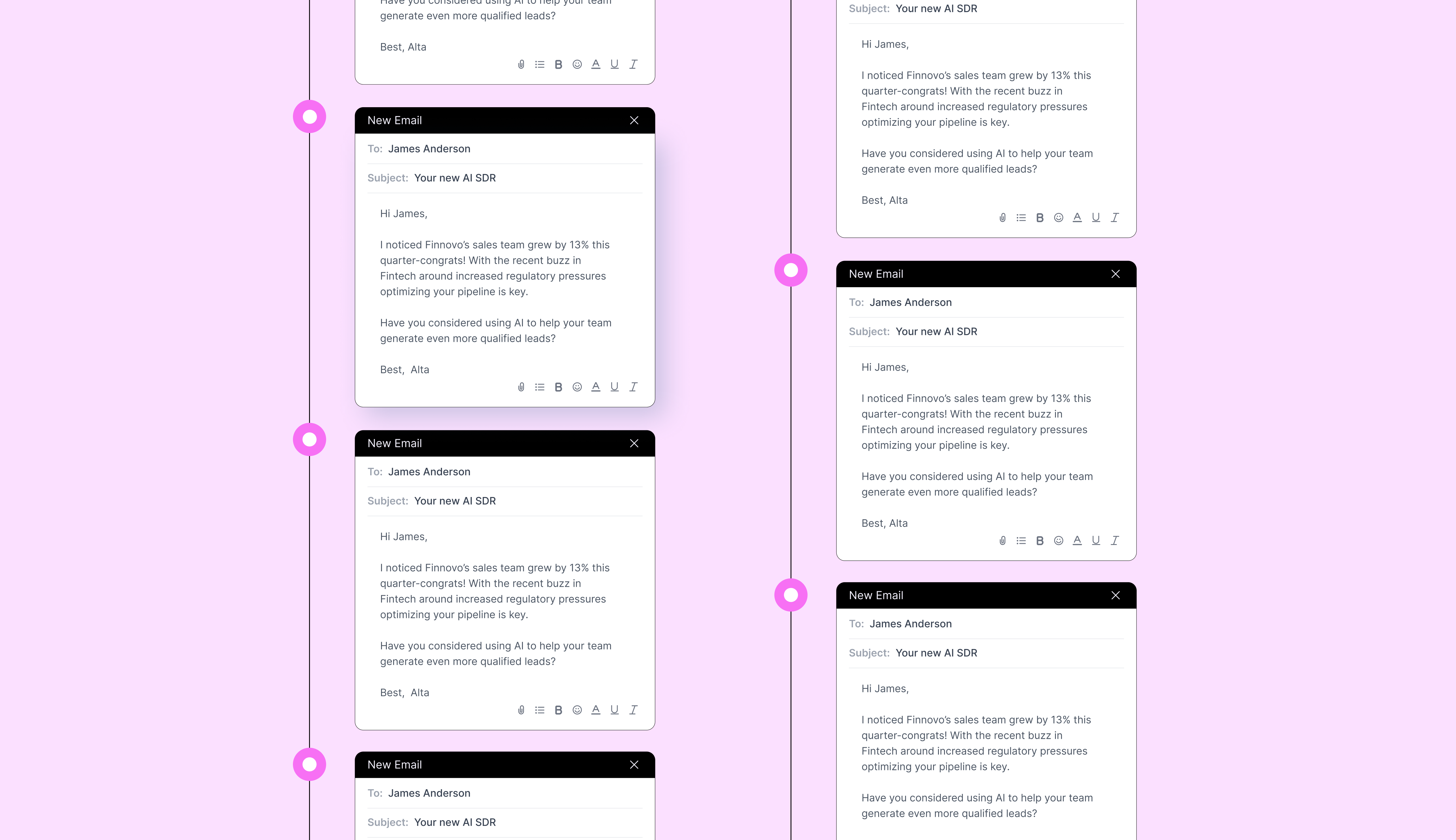
Rather than blasting out cookie-cutter emails, advanced AI SDRs analyze each prospect's behavior, past interactions, and industry trends to generate customized outreach sequences.
Picture a scenario where an AI SDR notices that a lead has been researching AI cold calling solutions. Instead of sending a generic "let's connect" email, the AI writes a tailored message:
"Hi [Prospect's Name], I noticed you've been exploring AI-driven cold calling solutions. Based on what we've seen in the industry, teams using AI SDRs see a 40% increase in successful connections. I'd love to share how our platform can help you streamline prospecting while keeping outreach personal. Would you be open to a quick call?"
This level of customization boosts response rates and makes AI SDRs a powerful asset for modern sales teams.
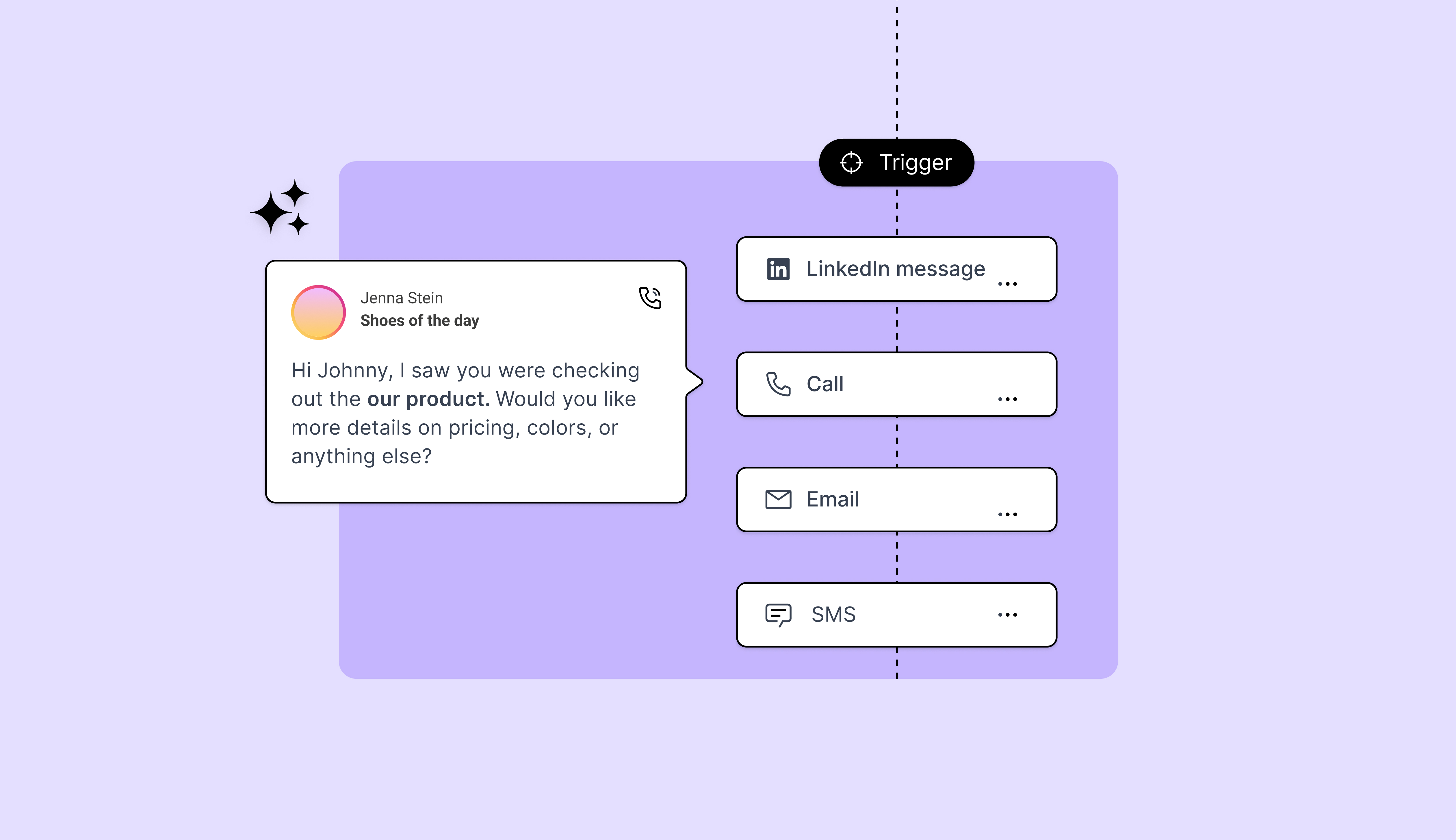
4. Multichannel engagement beyond just email
In the modern hectic sales environment, email alone isn't enough. The most effective AI sales automation platforms incorporate multichannel prospecting, allowing SDRs to engage leads across multiple touchpoints, including:
- AI cold calling that mimics human-like conversation flows
- AI-powered LinkedIn outreach for social selling
- SMS follow-ups based on engagement signals
- AI-driven chatbot conversations that qualify leads in real-time
By meeting prospects where they're comfortable engaging, AI SDRs increase the likelihood of conversion while cutting manual outreach.
5. Data-driven AI automation for smarter sales
AI SDRs are only as effective as the data they have to work with. The most powerful platforms leverage real-time insights from sources like your CRM, past campaigns, and customer interactions to refine their outreach on an ongoing basis.
By analyzing historical engagement, AI SDRs can identify the most promising segments, pinpoint your Ideal Customer Profile (ICP) and adjust their messaging based on what resonates best with each audience. With this self-learning capability, AI-driven outreach will improve over time, making every touchpoint — email, phone calls, LinkedIn message, etc. — optimized for conversion. Rather than static, stagnant automation, AI SDRs evolve dynamically to deliver hyper-personalized engagement at scale.
Real-World AI SDR Implementation Examples
Evaluation criteria are only useful when you can see them applied. The scenarios below map to the company shapes we see most often deploying AI SDRs today: a SaaS startup, a mid-market B2B company, an enterprise sales team, and an agency model. Each one includes the setup, the challenge, the AI SDR solution, the outcome pattern, and the key lessons that apply across situations.
SaaS startup (10-50 employees): scaling outbound without hiring more SDRs
Company background. A Series A B2B SaaS startup with a four-person GTM team, including two SDRs and two AEs. Growing quickly on inbound, but outbound coverage has stalled because research and drafting eat most of the SDRs' day.
Challenge. The two SDRs cap out at roughly 60 personalized touches per day. Pipeline targets require triple that volume. Hiring more SDRs isn't viable on current burn. Response rates on outbound sit in the low single digits, partly because personalization quality drops when the team tries to push volume.
AI SDR solution. Deployed an AI SDR platform to own prospect research, list-building, first-touch drafting, and follow-up sequencing across email and LinkedIn. Trained messaging on the team's top-performing sequences. SDRs shifted to live reply handling, qualification calls, and multi-threading.
Results. Research time across the team dropped from 20+ hours a week to under 5. Qualified meetings roughly tripled within the first quarter. Response rates climbed into the mid-to-high single digits because every touch now carried genuine personalization. The team covered a target list several times larger than before without adding headcount.
Key lesson. For lean GTM teams, AI SDRs aren't about doing more work, they're about removing the work that was blocking humans from the conversations that actually close deals.
Mid-market B2B company (200-500 employees): automating follow-up across a fragmented team
Company background. A mid-market B2B software company with a six-person SDR team and a mature outbound motion. Good playbook, decent top-of-funnel volume, but a persistent leak in the middle of the funnel where follow-up sequences go dark after the second or third touch.
Challenge. Roughly 80% of outbound opportunities were dying in follow-up. SDRs were diligent on the first two touches and inconsistent after that because live-reply handling and meeting prep took priority. Meeting-booking rates sat stuck around 12% of positive first replies.
AI SDR solution. Layered an AI SDR on top of the existing outbound motion to own all follow-up sequencing, from touch three through touch eight. Humans kept ownership of first-touch drafting and live conversations. AI handled the cadence, recency, and multi-channel follow-through that was falling through the cracks.
Results. Follow-up completion went from inconsistent to 100%. Meeting-booking rates roughly doubled because prospects who replied later in sequences actually got responses. The SDR team stopped feeling underwater on admin and spent noticeably more time on live conversations.
Key lesson. AI SDRs are especially powerful in the follow-up layer, where human inconsistency is the single biggest leak in most outbound motions. You don't have to hand over the whole workflow to see large ROI, start with the layer where humans underperform.
Enterprise sales team (1,000+ employees): account-based outbound at global scale
Company background. An enterprise software company with a 40-person SDR team spread across North America, EMEA, and APAC. Running ABM against a 2,000-account target list. Mature tech stack including data providers, enrichment tools, sequencers, and a CRM.
Challenge. Research quality varied widely across regions. Coverage on tail accounts (outside the top 200) was inconsistent because SDRs prioritized the accounts with warm signals. Messaging drifted from the approved playbook as tenured SDRs developed personal variants. Sales leadership lacked visibility into what was actually being sent and what worked.
AI SDR solution. Deployed AI across the full 2,000-account list to handle research, first-touch personalization, and follow-up, with messaging guardrails enforced centrally. SDRs retained ownership of live replies, qualification, and handoff to AEs. Data and activity synced back to the CRM automatically.
Results. Tail-account coverage went from patchy to full. Qualified meetings from outside the top 200 accounts lifted substantially, opening pipeline from accounts that had previously received zero touches. Messaging consistency improved because the AI worked from a single approved playbook. Leadership gained full visibility into send activity and response patterns for the first time.
Key lesson. For enterprise teams, the biggest AI SDR wins often come from coverage rather than automation. AI is the only economical way to run genuine personalization across a long-tail target list.
Agency and consultancy model: running outbound on behalf of clients
Company background. A B2B lead generation agency running outbound campaigns on behalf of 15+ clients simultaneously. Team of six across account management, copywriters, and list-building.
Challenge. Every client required bespoke messaging, ICP research, and campaign setup. The team spent most of their time on configuration and list-building, leaving limited capacity to actually optimize live campaigns. Scaling the client roster required near-linear hiring.
AI SDR solution. Standardized campaign setup on an AI SDR platform with per-client workspaces. Each client got their own ICP definition, messaging guardrails, and reporting. AI handled research, drafting, and sequencing across all accounts. The human team shifted focus to strategy, messaging review, and live optimization.
Results. Per-client campaign setup time dropped from weeks to days. The agency expanded its client roster without proportional headcount growth. Campaign quality became more consistent because the same underlying system produced the work across all clients, customized by configuration rather than by individual copywriters.
Key lesson. For agency and consultancy models, AI SDRs change the unit economics of client delivery. The work that used to require scaling a production team now scales with configuration.
The pattern across all four
The common thread is that AI SDRs pay off most when they take ownership of a defined layer of the workflow, not when they're bolted on as another drafting tool. The question is which layer of your outbound motion is leaking the most time or the most opportunities, and whether the AI can own that layer end-to-end. Teams that answer that question clearly before buying get the best results.
AI SDR Glossary: Key Terms and Comparisons
The AI SDR category has generated a lot of terminology, some of it load-bearing and some of it marketing noise. Here are the terms that actually matter when you're evaluating platforms, with the distinctions that make a difference.
AI SDR. An AI system that handles sales development work end-to-end, including prospect research, outreach drafting, multi-channel execution, follow-up sequencing, and lead qualification. An AI SDR like Katie pulls from 50+ data sources and runs outreach across email, LinkedIn, SMS, and calls autonomously. Unlike a traditional SDR who manually researches 10-15 prospects per day, an AI SDR can research, personalize, and engage hundreds of prospects in the same window while maintaining personalization quality.
Traditional (human) SDR. A sales development representative responsible for outbound prospecting, lead qualification, and meeting-setting. Typically handles 50-80 personalized touches per day and 10-15 qualified conversations per week. Traditional SDRs remain essential for live reply handling, complex qualification, and relationship depth, which is where humans consistently outperform AI.
Sales development representative (SDR). The role focused on the top of the sales funnel, responsible for generating qualified opportunities from cold prospects and inbound leads and handing them to account executives. The function exists whether it's performed by humans, AI, or a hybrid of both.
Lead qualification. The process of determining whether a prospect is a fit for your product and ready enough to have a sales conversation. Traditional lead qualification relies on a rep asking questions on a call. By contrast, AI-powered lead qualification uses CRM context and real-time signals to pre-qualify prospects before any human conversation happens, letting reps walk into every call with a lead that's already been vetted.
Prospecting automation. The use of software to automate steps in the prospecting workflow, including list-building, enrichment, outreach, and follow-up. Basic prospecting automation handles one or two of these steps; full AI SDRs handle the whole workflow as a coordinated motion rather than a set of disconnected tasks.
CRM integration. The connection between an AI SDR platform and your CRM (Salesforce, HubSpot, Pipedrive) so that every activity, response, and meeting flows back automatically. Surface-level integration just logs sends and opens. Deep integration uses CRM context (deal stage, past wins, account history) to shape outreach decisions and maintains the CRM as the single source of truth without requiring manual updates.
Outreach sequences. A pre-defined series of touches delivered across channels on a scheduled cadence, including email, LinkedIn, SMS, and calls. Traditional sequences are static: the same seven emails in the same order regardless of prospect behavior. AI-driven sequences adapt based on what the prospect actually does, switching channels, adjusting timing, and re-drafting messaging in response to engagement.
Lead scoring. The process of ranking prospects by their likelihood to convert. Manual lead scoring usually relies on a small number of criteria weighted by a rep or RevOps lead. AI-powered lead scoring uses predictive analytics across 50+ data points, including firmographic data, intent signals, and behavioral history, to rank prospects more accurately and update scores in real time as new signals arrive.
Sales pipeline automation. The use of AI and workflow tools to move opportunities through the pipeline without manual rep effort at every stage. This includes automatic activity logging, stage transitions triggered by prospect behavior, follow-up reminders, and task creation. Pipeline automation frees reps to focus on the conversations that require judgment instead of on CRM admin.
Conversion optimization. The ongoing process of tuning messaging, timing, channels, and targeting to improve the rate at which prospects convert from one stage of the funnel to the next. AI SDRs perform conversion optimization continuously by tracking what works across thousands of touches and adjusting future sequences accordingly, rather than waiting for a quarterly campaign review.
Speed to lead. The time between an inbound signal (form fill, demo request, content download) and the first response from your team. Leads contacted within the first 5 minutes are dramatically more likely to convert than those contacted after 30 minutes. AI inbound agents respond in seconds, which is a category of performance human teams can't match.
Agentic AI. AI systems that execute outcomes rather than individual tasks. A traditional automation sends the email you drafted; an agentic AI decides who to contact, researches them, drafts the message, sends it, follows up, and updates the CRM, checking in with a human only when a prospect is ready for a real conversation. Modern AI SDRs are agentic by design.
Final Thoughts: The Future of AI in Sales
We know, anything "AI" can sound trendy. But AI in sales isn't just a trend, it's a foundational shift in how businesses engage prospects, qualify leads, and close deals. Choosing the right AI SDR can mean the difference between a highly optimized sales engine and a disjointed, inefficient process and frustrated human reps.
By focusing on lead generation intelligence, CRM integration, personalization, and multichannel engagement, your business can leverage AI sales tools to reduce workload, improve efficiency, and drive higher conversions, all while keeping the human touch alive in sales conversations.
If you're ready to transform your sales process with AI-powered prospecting, explore how Alta's AI SDR can help you scale smarter.
Frequently Asked Questions
SDR tools are software platforms that help sales development teams identify prospects, manage outreach, and track engagement. They automate repetitive tasks like data entry, follow-ups, and contact research. This allows SDRs to spend more time having meaningful conversations with potential buyers. SDR tools also help teams maintain consistent messaging across channels. As a result, B2B sales teams can scale their outbound efforts more efficiently.
SDR tools improve lead quality by enriching contact data and filtering prospects based on fit and behavior. Many platforms use intent signals to identify accounts that are actively researching solutions. This helps SDRs focus on prospects who are more likely to engage. Automated personalization ensures outreach feels relevant and timely. Together, these capabilities increase reply rates and booked meetings.
A strong SDR tool should provide accurate and up-to-date contact information. It should integrate seamlessly with your CRM and other sales systems. Multi-channel outreach capabilities are important for reaching buyers across email, phone, and social platforms. Automation features help manage follow-ups and task prioritization. Analytics and reporting allow teams to continuously improve performance.
SDR tools are not designed to replace human sales representatives. Instead, they support SDRs by handling repetitive and time-consuming tasks. Automation allows reps to focus on building relationships and understanding buyer needs. Human judgment and communication remain critical in sales conversations. The most effective teams combine technology with skilled sales professionals.
SDR tools typically connect lead sources with sales execution systems. They sit between marketing platforms and the CRM to support prospecting and outreach. These tools help ensure leads are contacted quickly and consistently. Integration across systems improves visibility into the buyer journey. This creates a more efficient and coordinated B2B sales process.
SDR tools can play a critical role in executing account-based marketing by helping teams focus on high-value target accounts rather than broad prospect lists. Advanced filtering and enrichment features allow SDRs to identify key decision-makers within specific companies. Intent data and engagement tracking reveal when multiple stakeholders from the same account are showing buying signals. Multi-channel sequencing ensures consistent, coordinated outreach across email, phone, and social platforms. Integration with marketing automation platforms keeps messaging aligned with broader ABM campaigns. As a result, SDR teams can deliver more relevant outreach that increases engagement within strategically important accounts.
Sales leaders should monitor both activity metrics and outcome-based performance indicators when evaluating SDR tools. Key activity metrics include response time, number of touches per prospect, and channel mix across email, calls, and social outreach. Outcome metrics such as reply rates, meeting booking rates, and qualified opportunities provide deeper insight into pipeline impact. It is also important to track speed-to-lead, as faster engagement often correlates with higher conversion rates. Data accuracy and enrichment coverage can indicate whether prospecting tools are improving lead quality. By combining operational and revenue-focused metrics, leaders can determine whether their SDR technology is truly driving growth.